

Duration
Eligibility

Fees
Admission Open 2026-27 | M.Sc. (Agri.) Plant Breeding & Genetics
About the M.Sc. (Agri.) Plant Breeding & Genetics
Usha Martin University offers a specialized two-year postgraduate program called the M.Sc. Plant Breeding & Genetics course that aims to give students enhanced knowledge and abilities in the domains of genetics, plant breeding, and biotechnology. Students who want to become specialists in creating crops that are high-yielding, disease-resistant, and climate-resilient are the target audience for this program. Professionals with knowledge of plant genetics and breeding are essential to increasing agricultural production and resolving the issues that farmers confront today as the need for sustainable agriculture and food security grows globally.
This M.Sc. Agriculture course combines theoretical studies with practical exposure to various aspects of plant genetics, breeding techniques, molecular biology, and agricultural biotechnology. Graduates of the M.Sc. Plant Breeding & Genetics course will be well-prepared to pursue careers in research, plant breeding programs, agricultural biotechnology companies, and government agricultural departments.
Programme Overview
The main objectives of the M.Sc. Plant Breeding & Genetics program include:
- PEO1: Graduates will be able to develop the conceptual and practical knowledge, skills and competency related to the various aspects of agriculture and allied sciences
- PEO2: Graduates will be agricultural professionals or experts who will help to solve technological as well as production problems in the agriculture and allied fields.
- PEO3: Graduates will be able to develop entrepreneurial skills, creativity and innovation in the field of agricultural science and related sectors.
- PEO4: Graduates will be able to develop professional skills with ethical and moral responsibilities in the workplace/society and contribute to the country & economic growth & development.
- PEO5: Graduates will have the opportunity to pursue higher education in agriculture or allied sectors.
- PEO6: Graduates will be engaged in independent and life-long learning in the ever-changing agricultural production system or enterprise.
- PSO1: Students will care the plants and make sure they stay healthy. They will also assist ingenetic research of plant breeding collect specimens and samples and grow cultures of micro-organisms, prepare specimens for examination and perform experiments, write reports onresults and findings, check the quality of plants, set up and maintain instruments andequipment, set up, operate and maintain laboratories for botanical breeding.
- PSO2: Students will have skill how to develop a new variety through classical and modernapproaches in agricultural and horticultural crops for their economic value suitable undervarious agro climatic conditions.
On successfully completing the agriculture program the student will be able to:
- PO1: The basics of classical to molecular plant breeding including biotechnological, quantitative, and genomic techniques.
- PO2: Skill in self-designing, regional and crop specific plant breeding programs linking conventional and modern techniques; selection strategies for development of new varieties.
- PO3: Competency in collection, investigation and analysis of data sets using statistical software; interpretation of the genetic results to arrive at meaningful conclusions.
- PO4: Insight about various biotechnological tools, tissue culture techniques, principles behind transgenic crops and its ethical implications.
- PO5: Understand the importance of quantitative genetic analysis, identifying the genes and QTL analysis.
- PO6: Proficiency in mapping population, molecular marker assisted selection and its application in crop improvement and expertise in genomics, proteomics, bioinformatics and gene editing
- PO7: Significance of germplasm, biodiversity conservation in relation to Plant Variety Protection and Intellectual Property Rights.
The purpose of Usha Martin University’s M.Sc. Plant Breeding & Genetics program is to give students a thorough understanding of plant genetics, breeding techniques, and the use of biotechnological tools to improve crop productivity and quality. This program’s foundational subjects include:
- Principles of Plant Breeding
- Genetics and Genomics in Agriculture
- Molecular Breeding Techniques
- Biotechnology and Genetic Engineering in Crops
- Crop Improvement and Breeding Strategies
- Seed Technology and Quality Control
- Genetic Resources and Conservation
- Statistical Methods in Genetics
- Biotechnological Approaches in Plant Breeding
- Ethical Issues in Genetic Engineering
With an emphasis on applying genetics and biotechnology to solve agricultural problems, this extensive curriculum guarantees that students get a strong foundation in both conventional and contemporary breeding methods.
Vision:
To become a pioneer in creating and showcasing sustainable smart agriculture to meet the difficulties of next-generation farming on a global scale.
Mission:
- M1: To provide students with world-class education and training in agricultural science, technology, and business.
- M2: To provide the farming community with specially created technologies for increased productivity and better agricultural output.
- M3: To develop environmentally friendly technology to advance the agro-industry.
Why Choose the M.Sc. Plant Breeding & Genetics Course at Usha Martin University?
Usha Martin University’s M.Sc. Plant Breeding & Genetics program is well-known for its thorough curriculum, industry-focused approach, and knowledgeable staff. This course is unique for the following reasons:
- Well-Designed Curriculum—The course offers a blend of theoretical knowledge and practical training in modern breeding techniques and biotechnology.
- Experienced Faculty—Students learn from renowned experts in the fields of genetics, plant breeding, and biotechnology.
- Modern Infrastructure—The university is equipped with state-of-the-art laboratories, experimental farms, and research facilities.
- Industry Exposure—Collaborations with industry leaders and opportunities for internships at biotechnology firms and agricultural research institutes.
- Strong Placement Support—Usha Martin University offers guidance to students for securing rewarding careers in agriculture and biotechnology sectors.
- Affordable Fees & Scholarships—Financial assistance options are available for meritorious students.
- Holistic Development—The program focuses on enhancing critical thinking, research skills, and professional ethics.
- Workshops & Guest Lectures—Regular sessions by industry experts and researchers to provide insights into the latest trends in plant breeding and genetics.
Usha Martin University’s M.Sc. Plant Breeding & Genetics program provides the perfect foundation for individuals who want to work in plant genetics, breeding, and agricultural biotechnology. In addition to imparting advanced academic knowledge, this curriculum equips students to tackle real-world problems in agricultural production, genetic engineering, and plant development. It is a great option for anyone looking to have a big effect in the agriculture industry because of its strong curriculum, knowledgeable teachers, and hands-on experience.
Top Benefits of the M.Sc. (Agri.) Plant Breeding & Genetics Programs
Enrolling in the M.Sc. Plant Breeding & Genetics program at Usha Martin University offers numerous benefits:
- Comprehensive Curriculum—Covers all essential areas, including plant breeding, genetic engineering, molecular biology, and seed technology.
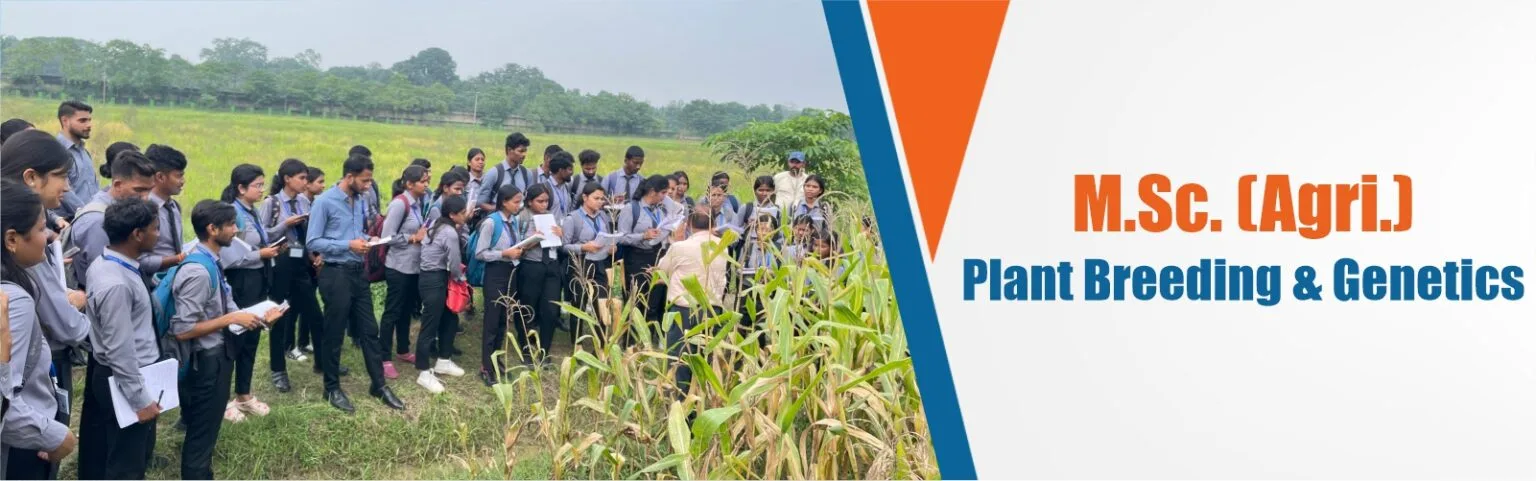
- Hands-on Training—Provides practical exposure through lab work, field visits, and research projects.
- Internship & Industry Exposure—Collaborations with agricultural research institutes, biotechnology firms, and seed companies.
- Skill Development—Focuses on technical, research, and problem-solving skills required for plant breeding professionals.
- Placement Assistance—Dedicated support to help students secure employment in leading agricultural organizations, biotech firms, and government sectors.
- Research Opportunities—Encourages students to participate in innovative research, tackling real-world agricultural problems using genetic tools.
Programme Curriculum
| Course Code | Course Title | Credit Hours |
| Major Courses | ||
| PBG 101 | Principles of Genetics | 2+1 |
| PBG 102 | Principles of plant breeding | 2+1 |
| PBG 103 | Fundamentals of quantitative genetics | 2+1 |
| PBG 104 | Varietal development and maintenance breeding | 1+1 |
| Minor Courses | ||
| AGRM 101 | Plant tissue culture and genetic transformation | 2+1 |
| Supporting Courses | ||
| AGRS 001 | StatisticalMethodsforAppliedSciences | 3+1 |
| Common Courses | ||
| AGRC 1001 | Library and information services | 0+1 |
| AGRC 1002 | Technical writing and communications skills | 0+1 |
| AGRC 1003 | Intellectual property and its management in agriculture | 1+0 |
| TOTAL | 21 | |
| Course Code | Course Title | Credit Hours |
| PBG 205 | Principle of cytogenetics | 2+1 |
| PBG 206 | Molecular breeding and bioinformatics | 2+1 |
| PBG 210 | Seed production and certification | 1+1 |
| Minor Courses | ||
| AGRM 102 | Molecular cell biology | 3+0 |
| Supporting Courses | ||
| AGRS 002 | Experimental Designs | 2+1 |
| Common Courses | ||
| AGRC 1004 | Basic concepts in laboratory techniques | 0+1 |
| AGRC 1005 | Agricultural research, research ethics and rural development programme | 0+1 |
| Course Code | Course Title | Credit Hours |
| Major Courses | ||
| PBG 311 | Crop Breeding- I (Kharif Crops) | 2+1 |
| Minor Courses | ||
| AGRM 103 | Fundamentals of Molecular Biology | 3+0 |
| PBG 550 | Seminar | 0+1 |
| TOTAL | 7 | |
| Course Code | Course Title | Credit Hours |
| PBG 560 | Thesis Research | 0+30 |
| OVERALL CREDIT | 72 |
Career opportunities After M.Sc. Plant Breeding & Genetics
There are several job options for graduates of the M.Sc. Plant Breeding & Genetics program in the fields of research, biotechnology, and agriculture. Among the most sought-after career positions are:
- Plant Breeder—Develops new crop varieties with improved yield, disease resistance, and environmental adaptability.
- Geneticist—Studies the genetic composition of plants and applies molecular techniques to improve crop characteristics.
- Biotechnologist—Works on applying genetic engineering and molecular biology in crop improvement and biotechnology.
- Agricultural Consultant—Advises on plant breeding techniques, agricultural practices, and crop improvement strategies.
- Seed Technologist—Specializes in seed production, quality control, and distribution.
- Research Scientist in Agriculture—Conducts research in plant genetics, molecular breeding, and biotechnological applications.
- Agricultural Extension Officer—Provides training and guidance to farmers on the implementation of modern breeding techniques.
- Plant Pathologist—Studies plant diseases and develops resistant crop varieties.
- Biotech Firm Manager—Manages biotechnological operations focused on plant breeding and genetic engineering.
Graduates can work for government agricultural agencies, private seed and crop production corporations, biotech companies, agricultural development groups, and research institutes.
I am text block. Click edit button to change this text. Lorem ipsum dolor sit amet, consectetur adipiscing elit. Ut elit tellus, luctus nec ullamcorper mattis, pulvinar dapibus leo.
Admission Open 2026 – Shape the Future of Crop Innovation
The future of farming will depend upon innovations, and genetics and plant breeding will help in the development of plants that produce high yields, have resistance against diseases, and can adapt to climatic changes. The course of Genetics and Plant Breeding offered at the university is for those students who wish to make contributions to the field of agricultural science.
Through practical experiments in the laboratories and field studies, you will learn about plant genetics, seed hybridization, biotechnology, and improvement methods for crops. With the help of this course, you will get ready for jobs in research centers, seed production companies, governments, and further education.
The admission process for the year 2026 is underway.
Admission Process – Simple & Easy at UMU
- Apply Online/Offline—Fill out the application form online or visit the campus.
- Upload Documents—Submit required academic documents.
- Eligibility Check—The university reviews the application.
- Admission Confirmation—Get confirmation after approval.
- Secure Your Seat—Pay fees and complete enrollment.
Frequently Asked Questions (FAQ's)
Candidates must have a B.Sc. in Agriculture or a related degree from a recognized university with the minimum required marks.
The program duration is 2 years, divided into 4 semesters.
You can work as a plant breeder, geneticist, seed technologist, or research associate or pursue a Ph.D. in agriculture-related fields.
Yes, students get extensive lab work, field experiments, and research exposure in plant breeding and genetics.
You can apply online by filling out the application form, submitting documents, and completing the admission process with university support.