This World Physiotherapy Day, Begin Your Journey in Healthcare
September 7, 2026
What is a BMLT course? Full Details, Eligibility, Fees & Career Scope
September 9, 2026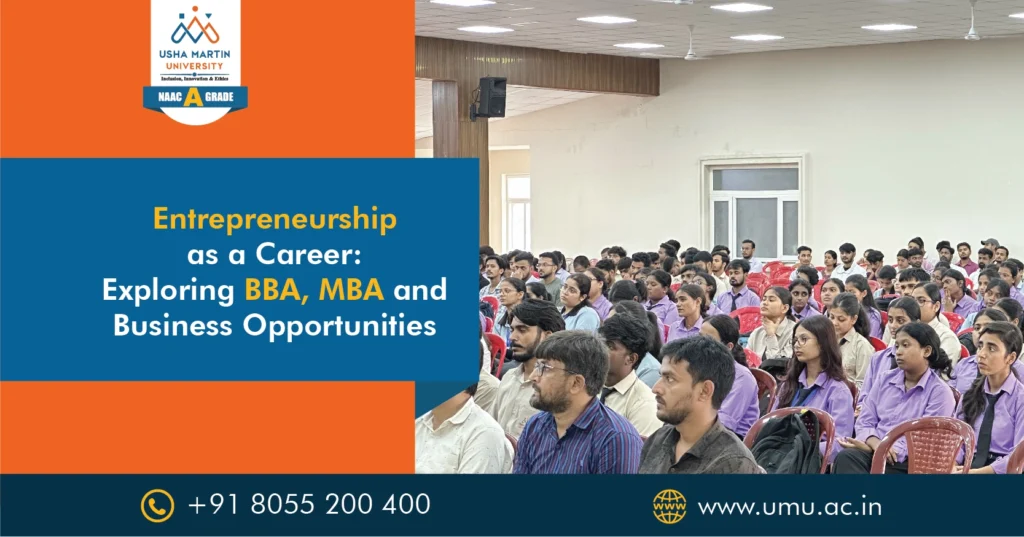
Entrepreneurship is no longer limited to established business owners or people with large investments. Today, it is increasingly becoming a mindset—one that encourages young people to identify opportunities, solve problems, create value, and build something of their own. Recognizing the importance of developing this mindset among students from an early age, the Institution’s Innovation Council (IIC) of Usha Martin University (UMU) organized an outreach program on “Entrepreneurship” at S.S. +2 High School, Childag, Ranchi, on August 27, 2026.
The program brought together more than 200 school students who participated enthusiastically in interactive sessions designed to introduce them to entrepreneurship, innovation, career opportunities, and the possibilities of self-employment. The initiative reflected UMU’s continuing efforts to take knowledge beyond the university campus and inspire young minds to think differently about their future.
Rather than presenting entrepreneurship simply as the act of starting a company, the program encouraged students to understand it as a way of thinking. Students were introduced to the importance of creativity, problem-solving, calculated risk-taking, leadership, resilience, and the ability to recognize opportunities around them.
Encouraging Students to Think Beyond Traditional Career Paths
For many students, the traditional idea of a successful career revolves around completing education, finding a job, and gradually progressing in an organization. While employment remains an important career path, entrepreneurship offers another possibility: becoming a job creator rather than only a job seeker.
This was one of the key messages delivered during the outreach program. Dr. Md. Saifullah Khalid, Associate Professor, Faculty of Business Management, Usha Martin University, conducted an engaging session on entrepreneurship and its future prospects. Through practical examples and relatable explanations, he helped students understand how entrepreneurial ideas can begin with simple observations of everyday problems.
The session highlighted that successful businesses do not always start with enormous resources. Often, they begin with a simple idea, a specific customer need, and the determination to turn that idea into reality.
Examples such as Haldiram and Zomato were used to demonstrate how entrepreneurial ventures can grow from comparatively simple beginnings into widely recognized businesses. These examples helped students understand an important lesson: entrepreneurship is not necessarily about having everything figured out from day one. It is about having the willingness to start, learn, improve, and adapt.
Students were encouraged to look around their own communities and identify problems that could potentially become opportunities. Whether it is a challenge related to food, transportation, agriculture, education, technology, local services, or everyday consumer needs, an entrepreneurial mindset begins by asking a simple question: “Can we find a better solution?”
What Does It Take to Become an Entrepreneur?
One of the important aspects of the session was understanding the qualities and skills required to become a successful entrepreneur. Students were introduced to qualities such as creativity, confidence, communication, leadership, decision-making, perseverance, adaptability, and problem-solving. They were also encouraged to understand that entrepreneurship involves learning from failure.
A business idea may not work perfectly on the first attempt. A product may need improvement. Customers may not respond as expected. An entrepreneur may have to change the business model or try a different approach. These experiences are not necessarily failures; they can become valuable learning opportunities.
For students, developing such qualities at an early age can be beneficial regardless of the career they eventually choose. Whether you later pursue an MBA program, a technology degree, an agriculture program, a professional course, or another career path, the ability to think creatively and solve problems can make a meaningful difference.
This is also why entrepreneurship education is becoming increasingly relevant in higher education. At Usha Martin University, we believe education should not only help you earn a qualification but also help you develop the confidence and skills needed to navigate a changing professional world.
From Classroom Learning to Real-World Opportunities
The outreach program also demonstrated the value of connecting education with real-world experiences. Students often learn concepts from textbooks, but understanding how those concepts operate outside the classroom can make learning more meaningful. Entrepreneurship provides a natural opportunity for students to connect education with everyday life.
For example, a student may notice that farmers in their area struggle to market their produce. Another student may observe that local customers have difficulty accessing a particular service. Someone else may identify an opportunity to process agricultural products instead of selling raw produce.
Each observation can become the starting point for a business idea. The objective is not to expect every school student to immediately become an entrepreneur. Instead, the purpose is to encourage young learners to develop curiosity and the habit of looking for solutions. This approach aligns with the broader objective of innovation-focused education—encouraging students to ask questions, experiment with ideas, understand challenges, and develop practical solutions.
Agri-Entrepreneurship: Turning Agriculture into an Opportunity
Entrepreneurship is not restricted to technology companies, restaurants, online platforms, or urban businesses. It can also create significant opportunities in agriculture and allied sectors.
Dr. Rupa Das, Assistant Professor, Faculty of Agriculture, Usha Martin University, introduced students to the concept of agri-entrepreneurship and explained the wide range of opportunities available within agriculture and allied activities.
Her session helped students look at agriculture from a broader perspective. Agriculture is often associated primarily with traditional crop cultivation. However, the modern agricultural ecosystem includes a wide range of activities, including fisheries, aquaculture, food processing, animal husbandry, mushroom cultivation, aquaponics, agricultural services, supply chains, agri-technology, and value-added products.
Students were introduced to entrepreneurial possibilities in areas such as fisheries, aquaponics, animal husbandry, and mushroom cultivation, among other agriculture-related ventures. For students from rural and semi-urban communities, this message can be particularly meaningful. Entrepreneurship can be built around local resources, local knowledge, and local needs.
A young person does not necessarily have to leave their community in search of employment if they can identify an opportunity to create sustainable economic activity within it. For example, agricultural products can potentially be processed, packaged, branded, and sold at higher value rather than being marketed only as raw produce. Similarly, mushroom cultivation, fisheries, livestock-related activities, and aquaponics can provide alternative avenues for enterprise development when supported by appropriate knowledge, planning, and market understanding.
The session therefore encouraged students to see agriculture not merely as a traditional occupation but as a sector with opportunities for innovation, entrepreneurship, and employment generation.
Why Entrepreneurship Education Matters for Young Students
The world of work is changing rapidly. Technology, artificial intelligence, digital platforms, changing consumer behavior, and new business models are creating opportunities that did not exist for previous generations. As a result, students today need more than academic knowledge. They need to develop the confidence to learn continuously, adapt to change, communicate ideas, work with others, and solve unfamiliar problems.
Entrepreneurship education can contribute to this development by helping students understand how ideas move from problems to solutions and eventually into products, services, or organizations. It can also encourage financial awareness, leadership, teamwork, innovation, and responsible decision-making.
At Usha Martin University, our approach to education is built around helping students prepare for both present and emerging career opportunities. This philosophy is reflected across our academic offerings, including BBA programs, MBA programs, and other management programs designed to develop professional knowledge and practical capabilities.
Building the Foundation for Future Management Professionals
For students who discover an interest in business and entrepreneurship, pursuing management education later can provide an opportunity to develop their ideas and professional skills further. A BBA program can introduce students to fundamental areas such as business management, marketing, finance, human resources, entrepreneurship, operations, and organizational behavior. It can help students understand how organizations operate and how different business functions work together.
After completing graduation, students may also explore MBA admission and choose from relevant MBA specializations based on their interests and career goals.
An MBA can provide deeper exposure to areas such as finance, marketing, human resource management, operations, business analytics, entrepreneurship, and other emerging management domains. The journey from a school-level entrepreneurship session to higher education may therefore become an important part of a student’s long-term career development.
We want students to understand that career planning does not need to begin only after graduation. You can start exploring your interests much earlier by asking yourself:
What problems do I enjoy solving?
What skills do I want to develop?
What kind of work excites me?
Could I build something that helps other people?
These questions can gradually help you identify whether entrepreneurship, management, technology, agriculture, or another field is right for you.
UMU’s Commitment to Innovation and Entrepreneurship
The outreach program was organized under the aegis of the Institution’s Innovation Council (IIC) at Usha Martin University, reinforcing the university’s commitment to creating an environment where innovation and entrepreneurship can flourish.
Such initiatives are important because innovation is not developed only through classroom lectures. It grows when students are encouraged to interact, question existing ideas, observe real-world challenges, and think about possible solutions.
By reaching out to school students, UMU is helping introduce these concepts at an early stage.
The program also represents the university’s broader belief that higher education institutions can play an important role in supporting the development of an entrepreneurial ecosystem. Universities can connect students with knowledge, mentors, faculty members, industry perspectives, innovation activities, and opportunities for practical learning.
For young learners, even a single interaction with an experienced faculty member can change the way they think about their future.
More Than 200 Students Participate Enthusiastically
More than 200 students participated in the program and actively engaged with the sessions. The enthusiastic participation demonstrated the curiosity among young learners to understand new career possibilities and explore opportunities beyond conventional employment.
The interactive nature of the program helped make the discussions accessible and relatable. Instead of limiting the conversation to theoretical definitions, the resource persons connected entrepreneurship with real businesses, everyday problems, agriculture, employment, and community development.
Students were encouraged to think creatively, identify opportunities, and consider innovative solutions to real-life problems. This kind of interaction can help students recognize that entrepreneurship is not reserved for a particular group of people. With the right mindset, knowledge, skills, support, and perseverance, entrepreneurial opportunities can be explored across different sectors.
From Job Seekers to Job Creators
One of the strongest messages from the program was the importance of developing a job-creation mindset. Employment remains an important part of economic development, but entrepreneurship can multiply opportunities by creating businesses that employ other people. When a young entrepreneur establishes a successful enterprise, the impact can extend beyond the individual. It can create employment, support suppliers, serve customers, encourage innovation, and contribute to the local economy.
For this reason, encouraging entrepreneurship among young people can have benefits that go beyond individual career growth. The message delivered at Childag was therefore not simply “start a business.” It was about developing the confidence to imagine possibilities.
If you see a problem, think about a solution.
If you see an opportunity, explore it.
If an idea fails, learn from it.
And if you have a vision, develop the skills needed to turn it into action.
Connecting School Education with Higher Education
Outreach initiatives such as this also create a meaningful bridge between schools and higher education institutions.
Students at the school level may have limited exposure to different professional fields. Interactions with university faculty can help them understand what they can study after school and how different academic programs connect with career opportunities.
For students interested in business, management, entrepreneurship, or leadership, programs such as BBA Admission and future MBA Admission can become part of their higher education journey.
Similarly, students interested in agriculture can explore specialized academic opportunities and develop their knowledge of modern farming, agribusiness, agri-technology, and allied sectors.
This broader exposure enables students to make more informed decisions about their education rather than choosing a course simply because others are pursuing it.
At UMU, we encourage you to look at higher education as an opportunity to discover your strengths, build relevant skills, and prepare yourself for the future you want to create.
Inspiring the Next Generation of Entrepreneurs
The outreach program at S.S. +2 High School, Childag, concluded on a positive and enthusiastic note. The interest shown by students reflected their willingness to learn more about entrepreneurship and consider it as a potential future career path.
For the Faculty of Business Management and the Faculty of Agriculture at Usha Martin University, the program provided an opportunity to share knowledge beyond the university campus and connect with young learners. For the students, it offered something equally valuable: a new perspective on what their future could look like.
Entrepreneurship may begin with a small idea, but its impact can become much larger when that idea addresses a genuine need. The students of today have access to technology, information, digital platforms, educational resources, and emerging markets that can help them explore possibilities in ways that were difficult for previous generations.
What they need is the confidence to begin.
The Road Ahead
The world needs professionals who can do their jobs well, but it also needs people who can identify new opportunities, solve problems, build organizations, create employment, and contribute to society.
This is why developing an entrepreneurial mindset among young students matters. The UMU-IIC outreach program at S.S. +2 High School, Childag, was a step in that direction. Through conversations around entrepreneurship, management, agriculture, innovation, and self-employment, students were encouraged to look beyond conventional career definitions and imagine themselves as future innovators and creators.
The program also reflected Usha Martin University’s continuing commitment to promoting innovation, practical learning, entrepreneurship, and self-reliance among young people.
Whether you eventually choose a BBA program, pursue one of the available MBA specializations, explore other management programs, or build a career in agriculture and allied sectors, the most important foundation remains the same: a willingness to learn, adapt, innovate, and take action.
The journey towards entrepreneurship does not necessarily begin with a company registration, an office, or a large investment.
It can begin with a question.
It can begin with an idea.
And sometimes, it can begin with a school student simply looking at a problem and asking, “How can I solve this?”
That is the entrepreneurial mindset that UMU-IIC sought to nurture among more than 200 students at Childag—and it is a mindset that can help shape the innovators, entrepreneurs, professionals, and job creators of tomorrow.