Apply Now! Last Date for Online UG & PG Admissions in Ranchi, Jharkhand
October 1, 2026
Diploma in Electrical Engineering After 10th with Placement Opportunities
November 19, 2026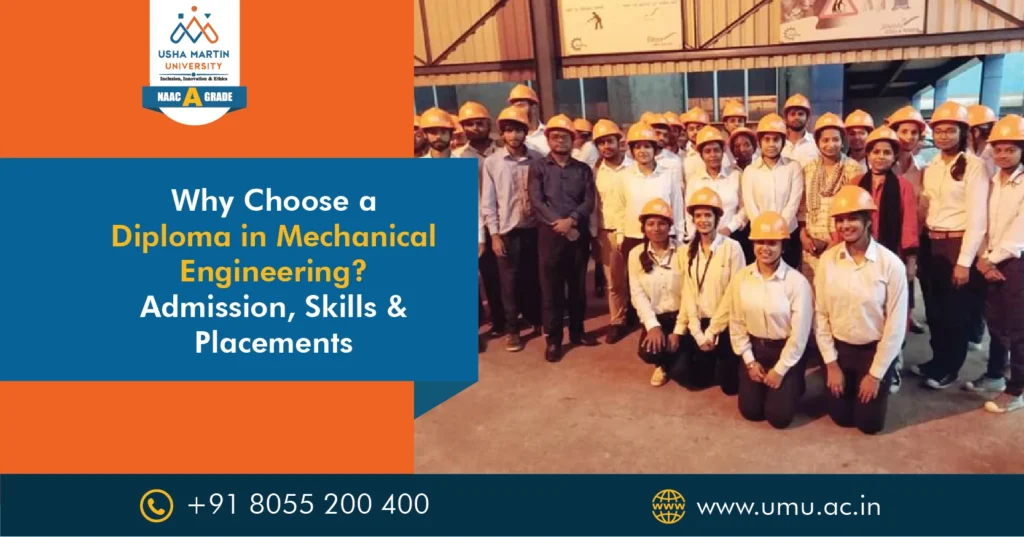
Choosing the right course after Class 10 can shape your academic journey and future career. If you are interested in machines, automobiles, manufacturing, technology and understanding how mechanical systems work, a Diploma in Mechanical Engineering can be a suitable choice. It gives you an opportunity to enter the engineering field early, develop technical knowledge and understand how machines and industrial equipment are designed, manufactured and maintained.
Mechanical engineering is one of the important branches of engineering because it connects scientific principles with practical applications. From automobile engines and aircraft components to manufacturing machinery, robotics, heating and cooling systems, mechanical engineering supports several industries. Almost every manufacturing process depends on machines, tools and mechanical systems that require skilled professionals for their design, production, operation and maintenance.
At our university, we understand that you want an engineering education that goes beyond classroom learning. You want to develop practical abilities, understand industry requirements and prepare for professional opportunities. Our Diploma in Mechanical Engineering programme introduces you to important mechanical engineering concepts through academic learning, practical sessions, laboratory work, projects and industry-related exposure. We aim to help you build a strong technical foundation and explore opportunities in the engineering and manufacturing sectors.
Our placement achievements also reflect the opportunities available to diploma students. Recently, 58 students from our Diploma Mechanical Engineering and Electrical Engineering programmes were selected by Banco Products India Limited for the position of Diploma Engineer Trainee (DET), with an annual package of ₹3 LPA and job locations across India. This achievement demonstrates an employment pathway that you can explore after completing technical education.
What Is a Diploma in Mechanical Engineering?
A Diploma in Mechanical Engineering is a technical programme that introduces you to the design, development, manufacturing, operation and maintenance of mechanical systems. It helps you understand how machines function and how different engineering principles are used to develop products and equipment.
At our university, we offer a three-year Diploma in Mechanical Engineering after Class 10. The programme focuses on fundamental engineering concepts and their applications in manufacturing and production industries. You learn how the principles of physics and mathematics are applied to mechanical design, machinery, materials, energy systems and industrial equipment.
For example, when you look at an automobile, several mechanical components work together to make it function. The engine, transmission system, braking mechanism, suspension and cooling arrangements are designed to perform specific tasks. Mechanical engineering helps you understand these systems and the principles behind their operation.
Similarly, manufacturing units use machines to convert raw materials into finished products. These processes involve tools, equipment, production techniques and quality checks. Through our diploma programme, we want you to understand how these activities are carried out and what technical knowledge is required to support them.
Why Choose a Diploma in Mechanical Engineering After 10th?
If you have completed Class 10 and enjoy practical subjects, machines and technology, a diploma course after 10th can be a valuable academic pathway. Instead of waiting until you complete Class 12 to begin technical education, you can start studying engineering fundamentals at an early stage.
One of the biggest advantages of a diploma is its practical orientation. Mechanical engineering involves understanding how machines work, how components are manufactured and how equipment is maintained. You develop this understanding through theoretical subjects as well as practical activities. We encourage you to participate in laboratory sessions, technical assignments and projects so that you can connect what you learn in the classroom with real applications.
Another reason to consider mechanical engineering is its wide industry presence. Manufacturing, automobile production, construction equipment, aviation, energy, industrial machinery and robotics all depend on mechanical systems. This creates opportunities across different technical fields.
A diploma also provides a foundation for further education. After completing the programme, eligible students can explore lateral-entry admission into relevant B.Tech programmes, subject to the admission regulations and eligibility requirements of the institution.
What Will You Learn in Mechanical Engineering Diploma Programs?
Our mechanical engineering diploma programme introduces you to different areas of mechanical engineering, beginning with basic engineering principles and progressing towards specialised technical subjects.
Engineering Mathematics, Physics and Chemistry help you understand the scientific foundation of engineering. These subjects are important because mechanical systems involve calculations, material properties, energy, motion and physical forces.
Basic Mechanical Engineering introduces you to machines, mechanical components and engineering systems. You learn how different parts function and how mechanical principles are used in industrial applications.
Material Science and Engineering help you understand metals, alloys and other engineering materials. You explore their properties and applications and learn why selecting the right material is important when manufacturing machine components.
Manufacturing Engineering introduces you to production methods, machining processes and the techniques used to convert raw materials into finished products. This knowledge is useful for understanding industrial production and manufacturing operations.
Thermal Engineering introduces you to heat, energy transfer and thermodynamic principles. These concepts are used in engines, power equipment, heating systems and industrial processes.
Fluid Mechanics and Hydraulic Machinery help you understand how liquids and gases behave and how fluid-based systems are used in industrial equipment, pumps and other mechanical applications.
We also encourage practical learning through laboratory sessions, workshops, technical projects and industrial exposure. Our programme information includes in-plant training in the final year, designed to support employability and entrepreneurship skills. This helps you understand how your academic knowledge relates to professional responsibilities.
Skills You Can Develop During a Diploma Course
A successful career in mechanical engineering requires more than knowing the names of machines and their components. You need to understand how equipment operates, how mechanical problems develop and how technical solutions can be implemented.
During your diploma education, we encourage you to develop mechanical troubleshooting skills. These help you understand equipment problems and examine possible causes. You also learn the importance of equipment maintenance, which involves inspection, servicing and maintaining machinery to support efficient operations.
Technical drawing and design understanding are important because mechanical professionals often work with engineering drawings, dimensions and component layouts. Manufacturing knowledge helps you understand machining processes, production methods and material selection.
You should also develop problem-solving, communication and teamwork abilities. In an industrial environment, you may need to coordinate with technicians, supervisors, engineers and production teams. Being able to explain a technical issue clearly and work responsibly with others can support your professional development.
We encourage you to take practical assignments seriously, participate in technical activities and maintain a record of the projects you complete. These experiences can help you explain your technical knowledge during interviews.
Career Opportunities After a Diploma in Mechanical Engineering
Mechanical engineering offers employment opportunities across manufacturing, automobile production, engineering services, construction, industrial machinery and other technical sectors. After completing your diploma, you can explore entry-level positions according to your technical knowledge, practical skills and the requirements of recruiting organisations.
You may begin your professional journey as a Diploma Engineer Trainee, where you get an opportunity to understand manufacturing processes, machinery and industrial operations. A trainee position can help you apply your technical knowledge while gaining workplace experience.
You can also explore positions such as Mechanical Technician, Maintenance Technician and Production Technician. These professionals work with equipment, machinery, production operations and maintenance activities. Their responsibilities may include inspecting machines, supporting production work, identifying faults and maintaining equipment.
With relevant experience and qualifications, you may also explore roles such as Junior Engineer, Mechanical Supervisor, Section Head, Sales Engineer and Process Development Technologist. Manufacturing companies also require professionals who understand production planning, equipment performance and process improvement.
The career path you follow will depend on your interests and the skills you develop during your education. You can also continue your studies to gain advanced technical knowledge and explore specialised areas of mechanical engineering.
Diploma Mechanical Placements: Our Achievement with Banco Products India Limited
We understand that placement opportunities are among the most important factors you consider while selecting an engineering programme. You want to know whether your technical education can help you explore employment and gain professional experience.
At our university, we are pleased to share that 58 students from our Diploma Mechanical Engineering and Diploma Electrical Engineering programmes were successfully selected by Banco Products India Limited for the position of Diploma Engineer Trainee (DET).
The selected students received an annual package of ₹3 LPA, and the job locations were across India. This recruitment achievement is an encouraging example of the employment opportunities available to our diploma students in the engineering and manufacturing sectors.
A Diploma Engineer Trainee position allows newly qualified candidates to begin working in an industrial environment, understand production processes and gain experience with technical teams. It can also help you develop an understanding of workplace responsibilities, industrial discipline and professional expectations.
Students Selected from the Mechanical Engineering Bran
We are proud to share that the following students from our Diploma in Mechanical Engineering program have been selected by Banco Products India Limited for the position of Diploma Engineer Trainee (DET). Their achievement reflects our commitment to providing students with industry exposure and opportunities to begin their professional journeys.
| Sl. No. | Student Name | Branch | Job Position | Company |
| 1 | Danish Kumar Mahto | Mechanical | Diploma Engineer Trainee (DET) | Banco Products India Limited |
| 2 | Kundan Kushawaha | Mechanical | Diploma Engineer Trainee (DET) | Banco Products India Limited |
| 3 | Satish Kumar | Mechanical | Diploma Engineer Trainee (DET) | Banco Products India Limited |
| 4 | Piyush Bharti | Mechanical | Diploma Engineer Trainee (DET) | Banco Products India Limited |
| 5 | Ankit Kumar Mahto | Mechanical | Diploma Engineer Trainee (DET) | Banco Products India Limited |
| 6 | Nikhil Kumar Singh | Mechanical | Diploma Engineer Trainee (DET) | Banco Products India Limited |
| 7 | Praveen Kumar Pandey | Mechanical | Diploma Engineer Trainee (DET) | Banco Products India Limited |
| 8 | Rahul Kumar | Mechanical | Diploma Engineer Trainee (DET) | Banco Products India Limited |
| 9 | Samir Ahmad | Mechanical | Diploma Engineer Trainee (DET) | Banco Products India Limited |
| 10 | Prince Kumar | Mechanical | Diploma Engineer Trainee (DET) | Banco Products India Limited |
| 11 | Ashwani Kumar Raj | Mechanical | Diploma Engineer Trainee (DET) | Banco Products India Limited |
| 12 | Rahul Munda | Mechanical | Diploma Engineer Trainee (DET) | Banco Products India Limited |
| 13 | Abhishek Mahto | Mechanical | Diploma Engineer Trainee (DET) | Banco Products India Limited |
| 14 | Jitendra Bediya | Mechanical | Diploma Engineer Trainee (DET) | Banco Products India Limited |
| 15 | Sourabh Das | Mechanical | Diploma Engineer Trainee (DET) | Banco Products India Limited |
| 16 | Arun Kumar | Mechanical | Diploma Engineer Trainee (DET) | Banco Products India Limited |
| 17 | Romit Kandir | Mechanical | Diploma Engineer Trainee (DET) | Banco Products India Limited |
How We Prepare You for Professional Opportunities
At our university, we believe that placement preparation should be an ongoing part of your academic journey. It should not begin only when you enter your final semester. You should develop your technical understanding, communication abilities and professional confidence throughout the programme.
We encourage you to participate in laboratory work, technical projects, workshops and industry-related activities. These experiences help you understand how machines operate and how engineering principles are applied in production environments.
We also focus on helping students prepare for recruitment through career guidance, interview practice, personality development and technical preparation. When you attend an interview, you may be asked to explain a mechanical component, describe a project or discuss how you would approach a basic equipment-related problem. Practical understanding can help you answer such questions more confidently.
Our aim is to help you develop the academic knowledge and professional abilities required to take the next step towards employment or higher education.
Future Scope of Mechanical Engineering in India
Mechanical engineering remains relevant across manufacturing, automobile production, infrastructure, energy, industrial automation and engineering services. As industries adopt newer technologies and modernise production systems, mechanical knowledge continues to play an important role in designing, manufacturing and maintaining equipment.
India’s manufacturing sector includes automobile production, engineering goods, machinery, metal processing and industrial equipment. These industries depend on professionals who understand materials, manufacturing methods, mechanical systems and production operations.
The expansion of electric mobility is also creating new technical areas. Electric vehicles depend on mechanical design, thermal management, battery enclosures, vehicle structures and manufacturing processes. Similarly, industrial automation and robotics require an understanding of mechanical components, production systems and equipment integration.
For you, these developments mean that mechanical engineering can lead to several technical career directions. You can begin with an entry-level position, gain professional experience and gradually develop specialised knowledge in manufacturing, maintenance, design or industrial operations.
Diploma Mechanical Engineering Admission at Our University
If you have completed Class 10 and want to pursue mechanical engineering, you can explore diploma mechanical engineering admission at our university in Ranchi.
Our three-year Diploma in Mechanical Engineering programme is open to candidates who have passed the Matriculation examination from a recognised board. We also provide a two-year lateral-entry pathway for eligible candidates with the prescribed educational qualifications, including specified Class 12 science or ITI backgrounds.
You can begin by exploring the programme details and understanding the eligibility requirements. The next step is to complete the admission application through the available online or offline process and submit the required academic and personal documents.
We encourage you to provide accurate information in your application and follow the admission instructions for the relevant academic session. Before completing the process, review the current programme fee, eligibility conditions and admission schedule so that you understand the requirements clearly.
Higher Education Options After a Diploma
After completing your diploma, you can explore employment or continue your education. Eligible candidates may consider lateral-entry admission into B.Tech Mechanical Engineering or a relevant engineering discipline, subject to the applicable admission criteria.
You can also develop specialised knowledge through training in manufacturing technology, computer-aided design, industrial automation, production management and maintenance systems. These areas can help you build additional technical capabilities according to your career interests.
We encourage you to consider both your immediate career goals and your long-term ambitions when deciding your next step. Whether you want to begin working or pursue higher education, a strong foundation in mechanical engineering can support your future development.
Begin Your Mechanical Engineering Journey with Our University
If you enjoy working with machines, understanding manufacturing processes and solving technical problems, mechanical engineering can be a meaningful career direction. A diploma helps you develop an understanding of mechanical systems and prepares you to explore opportunities in manufacturing, production, maintenance and other engineering fields.
At our university, we want you to learn through a combination of academic knowledge, practical experience and industry-oriented activities. Our students’ selection by Banco Products India Limited reflects one of the employment pathways available to diploma students.
Explore our Diploma in Mechanical Engineering programme, understand the admission requirements and take the next step towards your career goals. We encourage you to develop your technical abilities, make the most of practical learning and prepare for the opportunities ahead.
Learn Engineering. Build Practical Skills. Shape Your Future with Our University!
Frequently Asked Questions
Q1: Can I pursue a Diploma in Mechanical Engineering after 10th?
Yes. You can apply for a three-year Diploma in Mechanical Engineering after passing Class 10 from a recognised board, subject to the applicable admission requirements.
Q2: What is the duration of a Diploma in Mechanical Engineering?
The regular programme at our university is three years. Eligible candidates can also explore a two-year lateral-entry option.
Q3: What are the career opportunities after a mechanical engineering diploma?
You can explore entry-level positions such as Mechanical Technician, Diploma Engineer Trainee, Maintenance Technician, Production Technician and Junior Engineer, depending on the employer’s requirements and your qualifications.
Q4: Which industries hire mechanical diploma holders?
Manufacturing, automobile production, construction equipment, industrial machinery, engineering services and maintenance industries offer relevant technical opportunities.
Q5: What placement opportunities are available at our university?
Our placement announcement records the selection of 58 students from the Mechanical and Electrical diploma branches by Banco Products India Limited for Diploma Engineer Trainee positions at an annual package of ₹3 LPA.
Q6: Can I pursue B.Tech after a diploma?
Yes. Eligible diploma holders can explore lateral-entry admission into B.Tech programmes, subject to the admission rules and eligibility requirements of the relevant institution.