Top Career Opportunities After MBA in Marketing Admission in Ranchi, India
July 10, 2026
B.Sc. CVT vs B.Sc. Medical Lab Technology: Which Course is Better?
July 14, 2026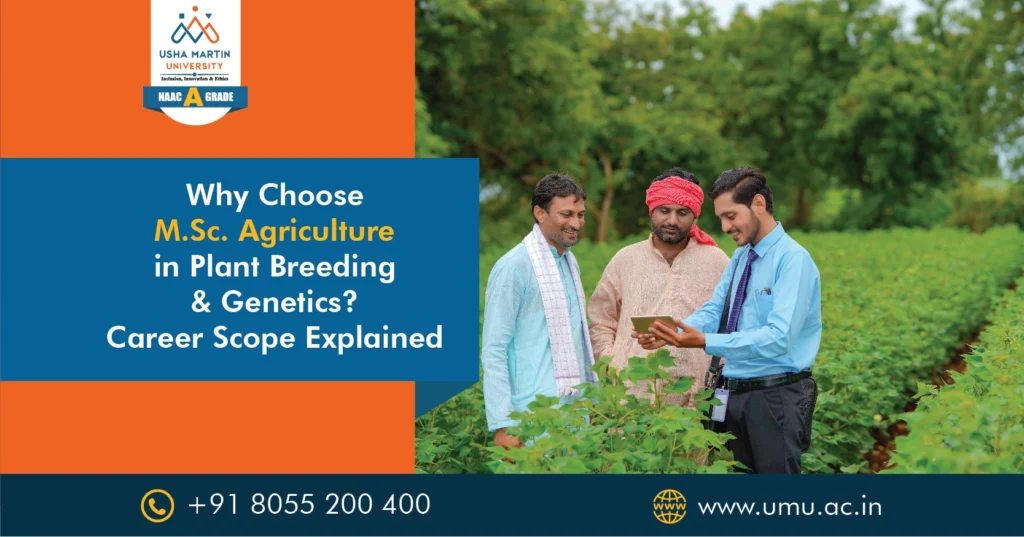
Agriculture is no longer limited to traditional farming methods. Today, it combines science, technology, innovation, and research to develop high-yielding, disease-resistant, and climate-resilient crops. If you have completed your bachelor’s degree in agriculture and want to contribute to the future of farming, an MSc Agriculture with a specialization in Plant Breeding & Genetics is one of the most rewarding career choices.
At Usha Martin University, Ranchi, we believe agriculture has the power to transform lives and strengthen the nation’s economy. Through our industry-oriented curriculum, advanced laboratories, experienced faculty, and research-driven learning environment, we prepare you to become a skilled agricultural scientist and innovator.
If you are searching for the best master of science programme in agriculture or looking for a top agriculture college in Ranchi, this programme can help you achieve your academic and professional goals.
About MSc Agriculture in Plant Breeding & Genetics
The (Master of Science) MSc Agriculture in Plant Breeding & Genetics is a two-year postgraduate programme that focuses on improving crop varieties through modern breeding techniques, genetics, biotechnology, molecular biology, seed technology, and agricultural research.
During the programme, we help you understand how crops can be developed to produce better yields, resist pests and diseases, tolerate climate change, and improve nutritional quality. You will gain both theoretical knowledge and practical exposure through laboratory work, field experiments, research projects, and seminars.
As agriculture continues to adopt scientific innovations, professionals specializing in plant breeding and genetics are increasingly in demand across government organizations, agricultural universities, research institutes, seed companies, biotechnology firms, and multinational agribusinesses.
Why Choose MSc Agriculture in Plant Breeding & Genetics?
Food security remains one of the biggest challenges across the world. Scientists are continuously working to develop crop varieties that can withstand changing climates, reduce production costs, and improve farmers’ income.
By choosing this specialization, you become part of this transformation.
Some major reasons why students prefer MSc Agriculture in Plant Breeding & Genetics include:
- Excellent career opportunities in research and development
- Growing demand in seed and biotechnology industries
- Opportunities in government agricultural departments
- Scope for higher education and PhD
- Contribution towards sustainable agriculture
- Better salary prospects than many traditional agriculture careers
- Opportunity to work on crop improvement projects
- International career opportunities in agricultural research
If your passion lies in innovation, research, genetics, and improving agricultural productivity, this specialization is an ideal choice.
MSc Agriculture Course Highlights
| Particular | Details |
| Course Name | MSc Agriculture |
| Specialization | Plant Breeding & Genetics |
| Course Duration | 2 Years |
| Eligibility | B.Sc. Agriculture or equivalent degree from a recognized university |
| Admission | Merit/University Admission Process |
| Mode | Full-Time |
| Career Areas | Research, Seed Industry, Biotechnology, Government Departments, Agricultural Universities |
Why is Plant Breeding & Genetics Important?
Plant breeding has played a significant role in increasing agricultural productivity over the past several decades.
Modern breeding techniques help develop crop varieties that offer:
- Higher yield
- Better nutritional value
- Disease resistance
- Pest resistance
- Drought tolerance
- Climate adaptability
- Improved quality
- Better shelf life
As climate conditions continue to change, experts trained in Plant Breeding & Genetics are becoming essential for sustainable agricultural development.
Through this MSc Agriculture programme, we prepare you to solve real agricultural challenges using scientific knowledge and advanced breeding techniques.
MSc Agriculture Eligibility
If you wish to pursue MSc Agriculture Admission 2026, you should meet the following eligibility criteria:
- Bachelor’s degree in Agriculture (B.Sc. Agriculture) or an equivalent qualification from a recognized university.
- Candidates must satisfy the eligibility norms prescribed by the university at the time of admission.
Students from different regions of India who are passionate about agricultural research and innovation are encouraged to apply.
MSc Agriculture Admission Process
The admission process is simple and student-friendly.
-
Step 1: Submit Your Application
Fill out the admission form with accurate academic and personal details.
-
Step 2: Document Verification
Submit the required educational documents for verification.
-
Step 3: Eligibility Assessment
The university evaluates your academic qualifications according to the admission guidelines.
-
Step 4: Admission Confirmation
After successful verification and completion of the admission formalities, your admission is confirmed.
We recommend applying early to secure your seat for the academic session.
Skills You Develop During MSc Agriculture
Our curriculum is designed to build both technical expertise and professional skills.
Throughout the programme, you will develop knowledge in:
- Plant Genetics
- Crop Improvement
- Seed Technology
- Biotechnology Applications
- Molecular Breeding
- Plant Tissue Culture
- Agricultural Research
- Genetic Engineering Basics
- Experimental Design
- Statistical Analysis
- Laboratory Techniques
- Scientific Writing
- Data Interpretation
- Research Methodology
- Crop Evaluation
- Field Trial Management
Along with technical knowledge, we also focus on communication, analytical thinking, teamwork, leadership, and problem-solving skills that help you succeed in professional environments.
What Will You Learn in MSc Agriculture?
The MSc Agriculture curriculum combines classroom learning with practical applications.
You will study subjects related to:
- Principles of Plant Breeding
- Genetics
- Cytogenetics
- Molecular Biology
- Quantitative Genetics
- Crop Improvement
- Seed Production Technology
- Plant Biotechnology
- Statistical Methods
- Experimental Design
- Bioinformatics
- Research Methodology
- Intellectual Property Rights in Agriculture
- Plant Genetic Resources
- Hybrid Seed Production
Besides academic learning, we encourage students to participate in field demonstrations, laboratory experiments, research activities, workshops, and seminars that enhance practical understanding.
Practical Learning at Usha Martin University
We believe agriculture education should go beyond textbooks.
That is why we emphasize experiential learning through:
- Modern laboratories
- Research-oriented practical sessions
- Crop field experiments
- Scientific seminars
- Expert lectures
- Project-based learning
- Industry interaction
- Dissertation work
- Agricultural surveys
- Field visits
This practical exposure enables you to understand real agricultural challenges and prepares you for professional responsibilities after graduation.
MSc Agriculture Syllabus (Plant Breeding & Genetics)
The MSc Agri Plant Breeding & Genetics curriculum is carefully designed to provide advanced knowledge in genetics, crop improvement, biotechnology, and agricultural research. Throughout the two-year programme, we combine classroom learning with laboratory practicals,field experiments, seminars, and dissertation work to ensure you gain both theoretical expertise and practical skills.
While the syllabus may vary slightly, students generally study the following subjects:
Semester I
- Principles of Plant Breeding
- Advanced Genetics
- Cytogenetics
- Biometrical Methods
- Research Methodology
- Practical Laboratory Work
Semester II
- Quantitative Genetics
- Molecular Biology
- Plant Biotechnology
- Crop Improvement Techniques
- Seed Science and Technology
- Statistical Analysis in Agriculture
Semester III
- Hybrid Seed Production
- Plant Genetic Resources
- Molecular Plant Breeding
- Intellectual Property Rights
- Seminar Presentation
- Research Project
Semester IV
- Dissertation
- Field Research
- Thesis Preparation
- Viva Voce
- Advanced Practical Training
By the end of the programme, you will have hands-on experience in crop evaluation, hybrid development, genetic analysis, plant improvement techniques, and research documentation.
Career Scope After MSc Agriculture in Plant Breeding & Genetics
The demand for professionals with an MSc Agriculture degree is increasing as India focuses on sustainable farming, food security, biotechnology, and agricultural innovation. Public and private organizations are investing heavily in research and development, creating excellent career opportunities for qualified graduates.
After completing your MSc Agriculture in Plant Breeding & Genetics, you can explore careers in:
- Agricultural Research Institutes
- Seed Production Companies
- Biotechnology Companies
- Agricultural Universities
- Government Agriculture Departments
- ICAR Research Centres
- Krishi Vigyan Kendras (KVKs)
- Plant Tissue Culture Laboratories
- Fertilizer and Agrochemical Companies
- Food Processing Industries
- NGOs working in agriculture and rural development
- International Agricultural Organizations
If you enjoy research, innovation, and scientific problem-solving, this specialization opens doors to impactful and rewarding careers.
Job Profiles After MSc Agriculture
Graduates of the MSc Agri specialization in gentics & Plant Breeding programme can pursue diverse job roles, including:
- Plant Breeder
- Agricultural Scientist
- Research Associate
- Genetics Research Officer
- Seed Production Officer
- Crop Improvement Specialist
- Agricultural Development Officer
- Biotechnology Executive
- Quality Control Officer
- Seed Certification Officer
- Agricultural Consultant
- Scientific Officer
- Field Research Coordinator
- Assistant Professor (after fulfilling applicable eligibility norms)
- PhD Research Scholar
These roles allow you to contribute to developing improved crop varieties, increasing agricultural productivity, and supporting sustainable farming practices.
MSc Agriculture Salary in India
One of the most common questions students ask is about salary after completing an MSc Agriculture.
Your salary depends on factors such as your skills, organization, location, experience, and job role. Fresh graduates generally receive competitive packages, while professionals with research experience and specialized expertise often earn significantly higher salaries.
Approximate salary ranges are:
| Job Role | Average Annual Salary* |
| Plant Breeder | ₹4–8 LPA |
| Research Associate | ₹4–7 LPA |
| Seed Production Officer | ₹4–8 LPA |
| Agricultural Scientist | ₹6–12 LPA |
| Biotechnology Executive | ₹5–10 LPA |
| Agricultural Consultant | ₹5–9 LPA |
Salary figures are indicative and may vary based on employer, experience, skills, and location.
Higher Education Opportunities
Completing an MSc Agriculture also lays a strong foundation for higher studies. If you aspire to become a researcher or academician, you can pursue:
- PhD in Plant Breeding & Genetics
- PhD in Agricultural Biotechnology
- PhD in Genetics
- PhD in Seed Science
- Postdoctoral Research
- National and international research fellowships
Higher education enhances your expertise and opens opportunities in teaching, advanced research, and leadership roles.
Why Plant Breeding & Genetics Has a Bright Future
Agriculture is evolving rapidly due to climate change, population growth, and increasing food demand. Scientists today are working to develop crop varieties that are more productive, nutritious, and resilient to environmental challenges.
This is where Plant Breeding & Genetics plays a vital role.
As governments and private organizations continue investing in agricultural innovation, professionals trained in this field are expected to remain in high demand. From developing drought-resistant crops to improving disease resistance and nutritional value, plant breeders contribute directly to global food security.
By pursuing an MSc Agriculture in this specialization, you become part of a profession that has a lasting impact on farmers, communities, and the future of agriculture.
Why Choose Usha Martin University for MSc Agriculture?
If you are searching for a top agriculture college in Ranchi or a reputed agriculture university for postgraduate studies, Usha Martin University offers a learning environment that combines academic excellence with practical exposure.
At Usha Martin University, we believe education should prepare you for real-world challenges. Our Master of Science programme in Plant Breeding & Genetics focuses on developing research skills, scientific thinking, and professional competence.
What Makes Usha Martin University Stand Out?
- Industry-oriented and research-focused curriculum
- Experienced faculty with academic and research expertise
- Well-equipped laboratories and modern learning facilities
- Practical field training and experimental learning
- Seminars, workshops, and expert interactions
- Focus on innovation and sustainable agriculture
- Student-centric teaching approach
- Personality development and skill enhancement programmes
- Career guidance and placement assistance
- Opportunities to participate in research projects and academic events
We strive to equip you with the knowledge and confidence required to succeed in research institutions, agribusiness companies, universities, and government organizations.
Admission Open 2026–27 | MSc Agriculture (Plant Breeding & Genetics)
If you are passionate about agricultural research, crop improvement, and scientific innovation, now is the right time to take the next step in your career.
Apply for MSc Agriculture Admission 2026 at Usha Martin University and gain advanced knowledge, practical exposure, and research experience in Plant Breeding & Genetics. With experienced faculty, modern infrastructure, and a curriculum aligned with industry and research needs, we help you build a successful career in agriculture.
Join a university that is committed to nurturing future agricultural scientists, researchers, and innovators.
Frequently Asked Questions (FAQs)
Q1: What is the duration of the MSc Agriculture programme in Plant Breeding & Genetics?
The programme is of two years and is divided into four semesters, covering advanced theoretical concepts, laboratory practicals, fieldwork, and research.
Q2: Who can apply for MSc Agriculture Admission?
Candidates who have completed B.Sc. Agriculture or an equivalent degree from a recognized university and meet the university’s eligibility criteria can apply.
Q3: What are the career opportunities after MSc Agriculture in Plant Breeding & Genetics?
Graduates can work as Plant Breeders, Agricultural Scientists, Research Associates, Seed Production Officers, Biotechnology Executives, Agricultural Consultants, and Research Officers in government and private organizations.
Q4: Is Plant Breeding & Genetics a good specialization?
Yes. It is one of the most promising specializations in agriculture because it focuses on crop improvement, sustainable farming, biotechnology, and food security, creating strong career opportunities in research and industry.
Q5: Why choose Usha Martin University for MSc Agriculture?
Usha Martin University offers experienced faculty, research-oriented education, modern laboratories, practical field training, industry-focused learning, and career support, making it an excellent choice for students seeking quality postgraduate education in agriculture.