Is B.Sc. Medical Laboratory Technology a Good Career Choice?
August 7, 2026
UMU Celebrates 80th Independence Day with Patriotism and Spirit of Nation Building
August 14, 2026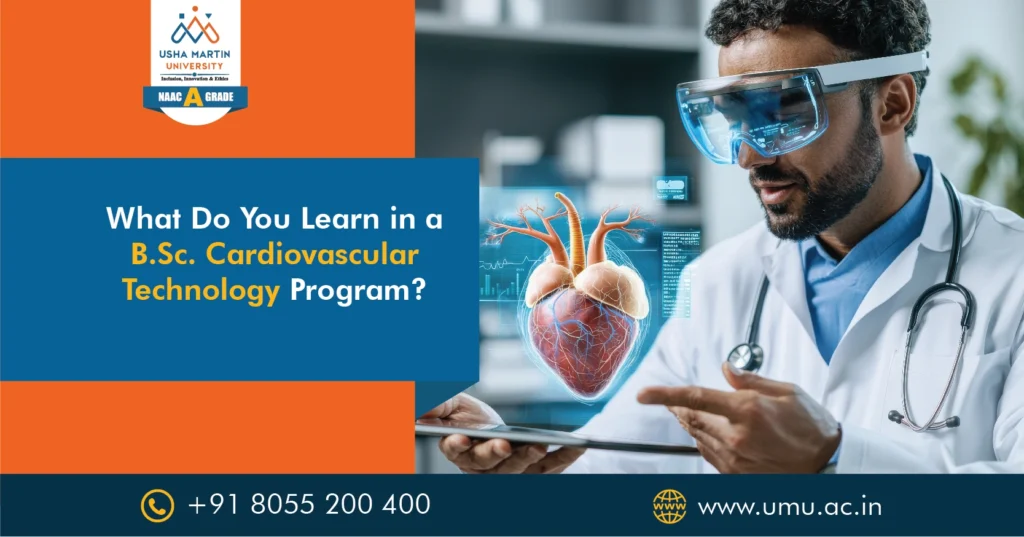
Have you ever wondered who performs and supports many of the specialised tests that help doctors understand how the heart is functioning? Who prepares patients for cardiac investigations, operates cardiovascular diagnostic equipment, monitors vital information and assists the cardiac care team during procedures?
This is where Cardiovascular Technology comes into the picture. If you are searching for BSc CVT programs, B.Sc CVT full form, B.Sc Cardiovascular Technology course, B.Sc CVT admission 2026, cardiovascular technology courses after 12th, or paramedical courses in Ranchi, you are probably trying to understand whether this healthcare field is suitable for your future.
The BSc CVT full form is Bachelor of Science in Cardiovascular Technology. It is an allied healthcare programme designed to develop professionals who can work with cardiovascular diagnostic and monitoring technologies and support doctors and other healthcare professionals in cardiac care.
At Usha Martin University (UMU), Ranchi, the B.Sc. Cardiovascular Technology programme is offered as a four-year undergraduate programme, combining academic learning with laboratory, practical and clinical exposure. The university’s current programme information describes a fourth-year, 12-month compulsory rotating clinical internship involving areas such as cardiac catheterisation laboratories, echocardiography, ECG/Holter/TMT units and intensive coronary care. But what exactly do you learn during these four years? Let’s explore it step by step.
What Is the B.Sc CVT Full Form?
First, let’s answer the most basic question. B.Sc CVT full form = Bachelor of Science in Cardiovascular Technology. It is a specialised allied healthcare degree focused on cardiovascular diagnostics, monitoring and clinical technologies.
The field is closely connected to cardiology because cardiovascular technologists work as part of multidisciplinary healthcare teams. The Ministry of Health and Family Welfare’s allied-health curriculum materials identify Cardiovascular Technologist, ECG Technologist and ECHO Technologist within the cardiology, vascular and pulmonary technology category.
This means B.Sc CVT is not simply a general science degree. It is a professional healthcare programme where you learn how medical science and specialised equipment come together in cardiac care.
Why Is Cardiovascular Technology Important?
Before choosing a healthcare course, you should understand why the field matters. Cardiovascular diseases remain the leading cause of death globally. The World Health Organization estimates that 19.8 million people died from cardiovascular diseases in 2022, accounting for approximately 32% of all deaths worldwide. Around 85% of these deaths were attributed to heart attacks and strokes. The WHO also notes that more than three-quarters of cardiovascular disease deaths occur in low- and middle-income countries.
These numbers explain why cardiac healthcare requires trained professionals across different roles. A cardiologist cannot do everything alone. Modern cardiac care depends on a team that can perform diagnostic procedures, monitor patients, operate specialised equipment, maintain safety standards and provide accurate technical information to doctors. That is one reason why BSc CVT programs have become an interesting option for students who want to enter healthcare without pursuing MBBS.
What Do You Learn in a B.Sc CVT Program?
A good B.Sc Cardiovascular Technology curriculum combines three broad areas:
Medical science + cardiovascular knowledge + technology and clinical skills. You begin with foundational subjects and gradually move towards specialised cardiac procedures and technologies. Let’s look at the major areas you can expect to study.
-
Human Anatomy
You cannot understand cardiovascular technology without understanding the human body.Anatomy introduces you to the structure of the human body, including organs, tissues, blood vessels and, importantly, the structure of the heart.
You learn about:
- Chambers of the heart
- Heart valves
- Arteries and veins
- Coronary circulation
- Major blood vessels
- Thoracic structures
- Cardiovascular anatomy
This knowledge becomes the foundation for understanding ECGs, echocardiography, catheterisation and other cardiovascular procedures.Think about it this way: if you do not understand where a structure is located, it becomes much harder to understand what an imaging or diagnostic procedure is showing you.
-
Human Physiology
Anatomy tells you what the body looks like.Physiology helps you understand how it works.In cardiovascular physiology, you learn how the heart contracts, how blood circulates, how electrical impulses travel through the heart and how blood pressure is regulated.
You may study concepts such as:
- Cardiac cycle
- Heart rate
- Blood pressure
- Cardiac output
- Electrical conduction
- Circulation
- Oxygen transport
- Regulation of cardiovascular function
This knowledge becomes extremely useful when you start interpreting the basic principles behind cardiovascular investigations.
-
Cardiovascular Anatomy and Diseases
As you progress through the programme, your focus becomes more specialised.You learn about cardiovascular diseases and conditions that affect the heart and blood vessels.
These may include:
- Coronary artery disease
- Heart failure
- Arrhythmias
- Valvular heart disease
- Congenital heart conditions
- Hypertension
- Peripheral vascular disorders
The WHO describes cardiovascular diseases as a group of disorders affecting the heart and blood vessels, including coronary heart disease, cerebrovascular disease, peripheral arterial disease, rheumatic heart disease and congenital heart disease.Understanding these conditions helps you understand why different diagnostic tests are performed.
-
Electrocardiography or ECG
One of the most important areas you encounter in cardiovascular technology is electrocardiography (ECG).An ECG records the electrical activity of the heart.In your B.Sc CVT course, you learn the principles behind ECG, electrode placement, patient preparation, recording techniques and basic interpretation within the scope of your professional role.
You may also encounter:
- Resting ECG
- Holter monitoring
- Exercise ECG/TMT
- Cardiac rhythm monitoring
At Usha Martin University, the programme specifically identifies ECG, Holter and TMT units among the clinical internship rotations.This practical exposure can help you understand how the theory you learn in the classroom is applied in a real clinical environment.
-
Echocardiography
Another important area is echocardiography, commonly known as an ECHO.An echocardiogram uses ultrasound to create images of the heart.During your training, you can learn the principles of cardiac ultrasound, patient preparation, positioning, basic measurements, image acquisition and the functioning of echocardiography equipment.
The Ministry of Health and Family Welfare recognises ECHO Technologist as an allied-health role within cardiology, vascular and pulmonary technology.At UMU, echocardiography is also included among the clinical areas identified for internship rotations.This is one of the reasons students interested in medical technology may find B.Sc CVT particularly engaging.
-
Cardiac Catheterisation
If you are interested in the more interventional side of cardiovascular healthcare, cardiac catheterisation is another important area.A cardiac catheterisation laboratory, or Cath Lab, is a specialised clinical environment where doctors perform diagnostic and interventional cardiovascular procedures.
As a cardiovascular technology student, you learn about the equipment, procedures, patient preparation, monitoring, sterile practices and technical support involved in the Cath Lab, within the scope of your training and professional responsibilities.Usha Martin University’s programme specifically identifies Cardiac Catheterisation Labs as part of the fourth-year clinical rotation.This exposure can help you understand the workflow surrounding procedures such as angiography and other cardiac interventions.
-
Patient Monitoring
Cardiac patients often require continuous monitoring.You therefore learn about cardiovascular monitoring systems and the physiological parameters that healthcare teams monitor.
Depending on the curriculum and clinical exposure, you may encounter monitoring of:
- Heart rate
- ECG rhythm
- Blood pressure
- Oxygen saturation
- Respiratory parameters
- Other vital signs
The objective is not simply to operate a monitor.You need to understand what the displayed information represents and when an abnormal observation should be brought to the attention of the appropriate healthcare professional.That requires both technical knowledge and clinical awareness.
-
Cardiac Emergency Care
Cardiac healthcare can involve emergency situations.For this reason, your training may include concepts related to emergency cardiovascular care, patient safety and basic life-support principles.The broader allied-health curriculum approach recommended by the Ministry of Health and Family Welfare emphasises clinical skills, communication, professionalism, basic life support and infection prevention as important components of healthcare education.This is an important part of becoming a responsible healthcare professional.You are not learning only to operate equipment.You are learning to work safely around real patients.
-
Medical Equipment and Technology
This is where the “technology” in Cardiovascular Technology becomes particularly important.You learn how specialised cardiovascular equipment works and how to use it appropriately under clinical protocols.
Depending on your programme and clinical exposure, this may include equipment associated with:
- ECG
- Holter monitoring
- TMT
- Echocardiography
- Cardiac catheterisation
- Patient monitoring
- Other cardiovascular diagnostic systems
Technology changes quickly.Therefore, your education should give you fundamental principles that allow you to continue learning new devices and systems throughout your career.At Usha Martin University, the B.Sc CVT programme highlights practical exposure through laboratories, hospitals, workshops and clinics.
-
Pharmacology and Medical Terminology
You may also study supporting subjects such as pharmacology and medical terminology.Why?Because you will work in a healthcare environment.You need to understand common medical terms and recognise the names and broad purposes of medications and procedures used around cardiovascular care.You are not being trained to independently prescribe medicines.Instead, the knowledge helps you communicate effectively with doctors, nurses and other healthcare professionals and understand clinical documentation and instructions.
-
Pathology and Microbiology
Healthcare is interconnected.Cardiovascular conditions can be influenced by infection, inflammation, metabolic disorders and other systemic conditions.Subjects such as pathology and microbiology help you understand disease processes and infection-control principles.This is particularly important when you work in environments such as cardiac catheterisation laboratories and intensive care units where strict clinical protocols are essential.
-
Patient Care and Communication
Here is something students sometimes underestimate:Healthcare is about people, not machines.You may become highly skilled at operating cardiovascular equipment, but you still need to communicate with patients.A patient undergoing a cardiac test may be frightened.They may not understand what is going to happen.They may be experiencing pain or anxiety.Your ability to communicate calmly and respectfully can make the clinical experience easier for the patient.This is why a strong B.Sc CVT programme should develop both technical and interpersonal skills.
-
Clinical Internship
Perhaps the most important part of your professional preparation is clinical exposure.
At Usha Martin University, the programme information describes a 12-month compulsory rotating clinical internship in the fourth year. The listed rotations include:
- Cardiac Catheterisation Lab
- Echocardiography
- ECG/Holter/TMT
- Intensive Coronary Care Unit
The internship is designed to move students from primarily classroom-based learning towards practical clinical environments.This is significant because healthcare cannot be mastered entirely through textbooks.
- You need to see how departments operate.
- You need to understand patient workflows.
- You need to observe clinical protocols.
- You need to develop confidence around equipment.
And you need to learn how different healthcare professionals work together.
What Skills Do You Develop During B.Sc CVT?
A strong B.Sc CVT programme should help you develop several categories of skills.
- Technical Skills: You learn how cardiovascular diagnostic and monitoring technologies work and how to use them safely within your role.
- Clinical Skills: You develop practical knowledge related to patient preparation, monitoring and clinical procedures.
- Communication Skills: You learn to communicate with patients and healthcare professionals.
- Observation Skills: Cardiovascular care requires attention to detail. You learn to recognise relevant observations and communicate them appropriately.
- Teamwork: Cardiac care is highly collaborative. You may work alongside cardiologists, nurses, technicians, perfusionists and other healthcare professionals.
- Professional Ethics: Healthcare professionals must respect patient dignity, privacy, safety and professional boundaries.
These skills can be just as important as your examination marks.
B.Sc CVT Course Duration at Usha Martin University
Students frequently search:”B.Sc CVT course duration?” At Usha Martin University, the B.Sc Cardiovascular Technology programme is listed as a four-year undergraduate programme. The university describes the fourth year as a compulsory 12-month clinical internship.
This structure gives you time to develop foundational knowledge before moving into more specialised clinical training.
B.Sc CVT Course Admission 2026
If you are searching for BSc CVT course admission 2026, Usha Martin University currently lists admissions for the B.Sc Cardiovascular Technology programme for the 2026-27 academic session.
The university’s admission portal lists B.Sc Cardiovascular Technology among its Faculty of Paramedical Sciences programmes. Before applying, you should verify the latest eligibility requirements, admission process, fees and documents directly with the university because these details can change between admission cycles. Do not rely on an old blog or social-media post for admission information.
Why Choose Usha Martin University for B.Sc CVT?
If you are searching for BSc CVT programs in Ranchi, the university environment should be one of your biggest considerations. Usha Martin University says its Faculty of Paramedical and Health Science combines theoretical education with practical and hands-on learning, research and clinical skills.
For B.Sc CVT students, the university’s programme information highlights:
- Industry-oriented curriculum
- Experienced faculty
- Practical and clinical exposure
- Modern laboratories and healthcare equipment
- Workshops and hospital training
- Skill-based learning
- Career guidance and placement assistance
UMU is a UGC-recognised private university established under the Jharkhand Act 2012, according to its official website. Its current admissions information also lists B.Sc Cardiovascular Technology among its paramedical programmes. For you, the important point is not simply that a university offers the course. The real question is: Will the programme give you enough academic knowledge and practical exposure to become competent in a real healthcare environment?
That is what you should investigate before admission.
Career Opportunities After B.Sc Cardiovascular Technology
After completing B.Sc CVT, your career can move into different cardiovascular healthcare environments depending on your skills, clinical experience and employer requirements.
Possible roles include:
- Cardiovascular Technologist
- ECG Technician/Technologist
- ECHO Technician/Technologist
- Cath Lab Technician/Technologist
- Cardiac Care Technician
- Cardiac Monitoring Professional
- Clinical Application Specialist in healthcare technology
- Medical Assistant in cardiology departments
Usha Martin University’s programme page specifically lists Cardiovascular Technologist, ECG Technician, Cath Lab Technician, Cardiac Care Technician, Echocardiography Technician and Medical Assistant in cardiology departments among potential job profiles.
The Ministry of Health and Family Welfare also identifies cardiovascular technologists and ECG/ECHO technologists within its allied-health framework.
What Can You Do After B.Sc CVT?
Your education does not necessarily end with your bachelor’s degree.Depending on eligibility and institutional requirements, you can explore higher education and specialisation.
Possible directions include:
- M.Sc. in Cardiovascular Technology
- Clinical research
- Hospital administration
- Healthcare management
- Specialised cardiovascular certifications
- Other relevant postgraduate healthcare programmes
Usha Martin University specifically lists postgraduate opportunities such as M.Sc./Ph.D. pathways in cardiovascular technology or related research areas and hospital administration among possible future directions.Your choice should depend on whether you want to remain strongly clinical, move into healthcare management, enter research or develop expertise in a specialised area.
Is B.Sc CVT a Good Career Option?
For the right student, it can be.The strongest reason is the combination of healthcare + technology + specialisation.Cardiovascular diseases remain a major global health burden. WHO’s latest fact sheet reports approximately 19.8 million cardiovascular deaths in 2022 and identifies cardiovascular disease as the leading global cause of death.
But you should avoid one common mistake:
Do not choose B.Sc CVT only because you believe it guarantees a high-paying job.
No degree can guarantee that.
Your professional growth will depend on:
- Quality of education
- Clinical exposure
- Technical competence
- Communication
- Practical experience
- Continuing education
- Employer
- Location
- Specialisation
- Professional performance
If you genuinely enjoy healthcare and medical technology, you are more likely to stay motivated long enough to develop these skills.
Who Should Choose B.Sc Cardiovascular Technology?
You may be a good fit if you:
- Studied science in Class 12
- Are interested in the human heart and cardiovascular system
- Enjoy medical technology
- Want to work in healthcare
- Prefer a specialised allied-health career
- Are comfortable working with patients
- Can work carefully under protocols
- Want practical clinical exposure
- Are interested in ECG, ECHO and cardiac technology
- Can work effectively as part of a healthcare team
You should think carefully before choosing it if you dislike science, technology, patient interaction or clinical environments.
B.Sc CVT vs Other Paramedical Courses
You may be comparing B.Sc CVT with B.Sc MLT, BMRIT, B.Sc OTT, BSc Respiratory Technology or B.Sc Optometry. There is no universal “best” course. The right course depends on the type of healthcare work you want. If you are fascinated by the heart, ECG, ECHO and cardiac procedures, CVT may be the better fit.If you are more interested in laboratory diagnostics, Medical Laboratory Technology may suit you. If you are interested in medical imaging, Radiology and Imaging Technology may be more relevant. If you are interested in surgical environments, Operation Theatre Technology may be worth exploring. This is why we recommend choosing the career role first and course second.
B.Sc. CVT vs B.Sc. Medical Lab Technology: Which Course is Better?
Final Takeaway
So, what do you learn in a B.Sc. Cardiovascular Technology program?
You learn much more than how to operate a cardiac machine.
- You learn how the heart works.
- You study cardiovascular diseases.
- You understand ECG and cardiac monitoring.
- You learn the fundamentals of echocardiography.
- You gain exposure to cardiac catheterisation.
- You learn about patient care and safety.
- You develop technical and communication skills.
And, importantly, you get the opportunity to take your knowledge into clinical environments.
The B.Sc CVT full form—Bachelor of Science in Cardiovascular Technology—represents a specialised pathway into allied healthcare at a time when cardiovascular disease continues to be a major global health challenge. WHO estimates that cardiovascular diseases caused approximately 19.8 million deaths worldwide in 2022, highlighting the continuing importance of cardiovascular prevention, diagnosis and care.
For students looking for BSc CVT programs in Ranchi, Usha Martin University offers a four-year B.Sc Cardiovascular Technology programme with practical learning and a structured clinical internship that includes exposure to Cath Labs, ECHO, ECG/Holter/TMT and ICCU environments.
Your next step should not be to ask only, “Is B.Sc CVT a good course?”Ask something more useful:”Can I see myself working with cardiac technology, patients and healthcare teams every day?”If your answer is yes, B.Sc Cardiovascular Technology could be a meaningful starting point for your healthcare career.
Frequently Asked Questions
Q1: What is the B.Sc CVT full form?
The B.Sc CVT full form is Bachelor of Science in Cardiovascular Technology.
Q2: What is B.Sc Cardiovascular Technology?
B.Sc Cardiovascular Technology is an undergraduate allied healthcare programme focused on cardiovascular diagnostics, monitoring technologies, patient care and clinical support.
Q3: How long is the B.Sc CVT course?
At Usha Martin University, B.Sc Cardiovascular Technology is a four-year programme, with the fourth year described as a 12-month compulsory clinical internship.
Q4: What do you study in B.Sc CVT?
You study areas related to anatomy, physiology, cardiovascular diseases, ECG, echocardiography, cardiac catheterisation, cardiovascular monitoring, patient care, medical technology, clinical procedures and related healthcare sciences.
Q5: Is B.Sc CVT a paramedical course?
It is an allied healthcare programme. The Ministry of Health and Family Welfare’s curriculum materials place cardiovascular technology within cardiology, vascular and pulmonary technology under allied health professions.
Q6: Can I study B.Sc CVT in Ranchi?
Yes. Usha Martin University in Ranchi currently offers B.Sc Cardiovascular Technology and lists it among its paramedical programmes.
Q7: What are the career options after B.Sc CVT?
Career opportunities can include cardiovascular technologist, ECG technician, ECHO technician, Cath Lab technician, cardiac care technician and related healthcare technology roles, subject to employer and applicable professional requirements.
Q8: Is clinical training important in B.Sc CVT?
Yes. Cardiovascular technology is a practical healthcare discipline, so clinical exposure is highly important. UMU’s programme includes a 12-month clinical internship in its fourth year.