Why Usha Martin University Is Emerging as a Hub for Skill-Based Education
August 19, 2026
Why Skill-Based Learning Is Shaping the Future of Higher Education in India
August 25, 2026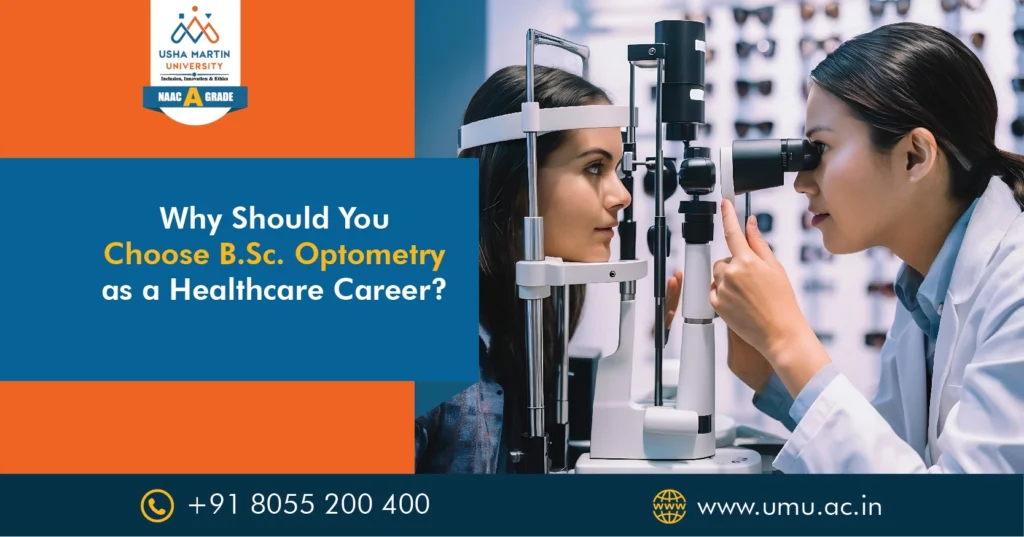
What if your interest in healthcare could lead you to a profession where you help people see more clearly, detect vision problems early, and contribute to better eye health—without pursuing an MBBS degree?
That is where a B.Sc. in Optometry can offer an interesting career path. If you are searching for B.Sc Optometry course admission, B.Sc.B.Sc. Optometry programs, B.Sc. Optometry courses in Ranchi, or after 12th B.Sc. Optometry programs, or looking for a top paramedical college in Ranchi, you may already be exploring alternatives to conventional medical courses.
But choosing a healthcare course should not be about following what everyone else is doing. You should first understand what the profession involves, what you will learn, where you can work, what skills you need, and whether the career actually matches your interests.
At Usha Martin University (UMU), Ranchi, the B.Sc. Optometry program is designed as a four-year undergraduate healthcare program combining academic education with practical and clinical learning. The university describes the program as focusing on vision science, eye health, clinical optometry, contact lenses, ocular conditions, vision assessment, and related areas. So, why should you consider a B.Sc. in Optometry? The answer becomes clearer when you understand the growing importance of eye care.
What Is B.Sc. Optometry?
B.Sc. Optometry is an undergraduate healthcare program focused on vision, eye health, visual assessment, and primary eye care.
The Ministry of Health and Family Welfare’s model curriculum for optometry describes the bachelor’s-level pathway as a four-year program and outlines competencies including comprehensive eye examination, ophthalmic investigations, refractive correction, contact lens practice, low-vision care, binocular vision assessment, early detection of ocular conditions, and appropriate referral.
In simple terms, an optometrist is a trained eye-care professional who assesses vision and provides a range of eye and vision-care services within their professional scope.
This means your work can involve much more than checking whether someone needs spectacles. You may assess visual function, identify refractive errors, work with corrective lenses, screen for eye conditions, provide low-vision support, and refer patients to ophthalmologists or other healthcare professionals when necessary.
The Government of India’s Ministry of Health and Family Welfare also lists optometry as a healthcare profession within its allied and healthcare professions framework.
Why Is Optometry Important in Today’s Healthcare System?
Let’s start with a simple question:
How much of your daily life depends on your vision?
- You read this article through a screen.
- You travel by looking at roads and signs.
- You study from books and digital devices.
- You work, communicate, and perform everyday activities using visual information.
Now consider what happens when someone’s vision is impaired and they cannot access timely eye care.
According to the World Health Organization, at least 2.2 billion people worldwide have near or distance vision impairment, and at least 1 billion cases could have been prevented or are yet to be addressed. Refractive errors and cataracts are among the leading causes of vision impairment and blindness.
WHO also reports that approximately 90% of people with unaddressed vision impairment or blindness live in low- and middle-income countries. These figures show why eye care is not a luxury. It is an important part of healthcare. And this is where trained eyecare professionals can make a meaningful contribution.
Why Choose B.Sc. Optometry After 12th?
If you have completed Class 12 with a science background and want to enter healthcare, you may have already considered courses such as B.Sc. Nursing, B.Pharm, B.Sc. Medical Laboratory Technology, B.Sc. Radiology, or B.Sc. Operation Theatre Technology. So why choose optometry? Because it offers a specialized combination of healthcare, science, technology, patient interaction, and clinical practice.
You can build knowledge about the eye while developing practical skills for vision assessment and eye care.
It can be particularly suitable if you:
- Enjoy biology and human anatomy
- Are interested in healthcare
- Like working directly with patients
- Have good attention to detail
- Enjoy technology and diagnostic instruments
- Want a specialized healthcare career
- Are interested in eye health
- Want to contribute to preventive healthcare
- Prefer a clinical career without becoming a doctor
The important point is that you should choose B.Sc. optometry because the work interests you—not simply because it is a healthcare course.
-
You Work in a Profession That Directly Improves Quality of Life
Imagine a child struggling to read the blackboard because of an uncorrected refractive error. Imagine a student who cannot concentrate because their vision is blurred. Imagine an older adult struggling with daily activities because of declining vision. Sometimes, improving someone’s visual function can make a profound difference to their education, independence, work, and quality of life.
WHO notes that vision impairment can have significant consequences across the life course and that timely access to appropriate eye care can mitigate many of these effects. As an optometry professional, your work can therefore have a direct human impact. You are not simply testing eyesight. You are helping people function better in everyday life.
-
You Learn About the Most Complex Optical System: The Human Eye
One of the most fascinating aspects of a B.Sc. in Optometry is the science behind vision. You learn about the structure and function of the eye and the visual system.
Your education may cover areas such as:
- Ocular anatomy
- Ocular physiology
- Visual optics
- Geometrical optics
- Physiological optics
- Binocular vision
- Ocular pathology
- Pharmacology
- Clinical optometry
The Ministry of Health and Family Welfare’s optometry curriculum specifically aims to develop knowledge of ocular structures, their functions, and pathological changes.
You therefore learn not only what the eye looks like, but also how it works and what can go wrong.
-
You Develop Practical Eye-Examination Skills
Optometry is a practical healthcare profession. You are not expected to spend four years simply memorising textbooks. A major component of your education involves learning how to examine vision and assess different aspects of visual function.
Depending on your curriculum and clinical training, you may learn about:
- Visual acuity assessment
- Refraction
- Binocular vision
- Color vision
- Visual field assessment
- Ocular health assessment
- Ophthalmic instruments
- Basic clinical procedures
The national optometry curriculum states that graduates should develop skills for comprehensive eye examination and ophthalmic investigations.
That practical component can make your education much more engaging if you enjoy learning by doing.
-
You Learn How Refractive Errors Are Corrected
Refractive errors are among the leading causes of vision impairment globally.
Myopia, hypermetropia, and astigmatism can affect how clearly a person sees.
An optometry program teaches you the principles behind detecting and correcting refractive errors. You learn how to assess vision and determine appropriate corrective solutions within your professional scope.
This may include spectacle prescriptions and, with appropriate training, contact lenses. WHO identifies uncorrected refractive error as one of the leading causes of vision impairment and blindness worldwide. So the knowledge you gain is directly connected to one of the most common global eye-care needs.
-
Contact Lens Practice Adds Another Career Skill
Spectacles are not the only way to correct refractive errors. Contact lenses can be useful for certain patients and visual requirements. The national optometry curriculum includes the ability to fit, evaluate, prescribe, and dispense contact lenses as one of the expected competencies of bachelor’s-level optometry education.
During your education, you can therefore learn about:
- Types of contact lenses
- Lens materials
- Fitting principles
- Patient assessment
- Lens care
- Hygiene
- Follow-up
- Complications and referral
This gives you another area of professional expertise.
-
You Learn to Recognize Eye Diseases
Here is one of the most important aspects of optometry: Not every vision problem is simply a requirement for spectacles. Certain changes in vision may indicate an underlying ocular or systemic condition. The national curriculum identifies early detection of conditions such as refractive error, strabismus, cataract, diabetic retinopathy, and glaucoma among the learning objectives for optometry graduates.
This does not mean an optometrist replaces an ophthalmologist. Instead, optometry education prepares you to assess and identify potential abnormalities within your scope and refer patients appropriately when specialist medical or surgical care is required. That referral relationship is an important part of safe healthcare.
-
You Can Develop Skills in Low-Vision Care
Not every patient can achieve normal vision even with conventional correction. People with significant visual impairment may require rehabilitation strategies, low-vision devices, and practical support. The Ministry of Health and Family Welfare’s optometry curriculum includes low-vision assessment and comprehensive low-vision care among its learning objectives. This is particularly meaningful because eye care is not only about restoring perfect vision. Sometimes the goal is to help a person make the best possible use of the vision they have.
-
You Learn About Binocular Vision
Your two eyes do not work independently. They need to coordinate with each other to produce comfortable and effective binocular vision.
Optometry education can therefore include:
- Binocular vision
- Accommodation
- Convergence
- Eye movements
- Non-strabismic binocular vision anomalies
- Visual comfort
The national curriculum specifically includes complete binocular vision assessment and management of non-strabismic binocular vision anomalies within the graduate competencies.
This can become particularly relevant when working with children, students, and patients experiencing visual discomfort or certain functional vision problems.
-
You Work With Modern Ophthalmic Equipment
If you enjoy healthcare technology, optometry can be a good fit. Modern eye care uses a wide range of instruments to assess different aspects of the eye and vision. Your training can introduce you to ophthalmic instruments and diagnostic procedures used in clinical settings.
This makes the course a blend of the following: Biology + Physics + Optics + Technology + Healthcare.
That combination is one of the reasons B.Sc. Optometry can appeal to students who want something more specialized than a general science degree.
-
You Develop Patient Care and Communication Skills
Technical skills alone do not make a good healthcare professional. Imagine that a patient is nervous because they have never undergone an eye examination. You need to communicate clearly. You need to listen. You need to explain procedures. You need to maintain patient dignity and confidentiality. You may also need to explain how to use spectacles or contact lenses properly and when a patient should return for follow-up. The Ministry of Health and Family Welfare’s optometry curriculum emphasizes the optometrist’s role as part of a multidisciplinary healthcare team and includes counseling, referral, and patient-care responsibilities.
That human connection can become one of the most rewarding parts of the profession.
B.Sc. Optometry Course in Ranchi: Why Consider Usha Martin University?
If you are specifically searching for a B.Sc. Optometry course in Ranchi, your choice of institution deserves careful attention. Usha Martin University offers a B.Sc. Optometry program and describes its paramedical and health sciences education as combining classroom teaching with laboratory training, clinical learning, and industry-focused education. The university currently lists admissions open for the 2026-27 academic session and provides online and offline application options.
UMU’s program information describes B.Sc. Optometry as a four-year undergraduate course covering areas including ocular anatomy, visual optics, clinical optometry, contact lens practice, low-vision care, ophthalmic instruments, ocular diseases, refraction, and community eye health. For you, this means the program is designed around the core knowledge and practical skills required to enter the eye-care field.
What Should You Look for in B.Sc. Optometry Programs?
You will find many B.Sc. optometry programs while searching online. But not every program should be evaluated in exactly the same way.
Before choosing one, ask:
Does the curriculum have enough clinical content? A healthcare degree should prepare you for real patients, not only examinations. Is practical training available? Look for laboratories, clinical demonstrations, and supervised hands-on learning. Is there an internship or hospital exposure? Clinical exposure helps you understand how eye-care services function outside the classroom. Are faculty members appropriately qualified?Faculty quality can directly influence your academic and practical development. Does the university provide modern equipment? Optometry is technology-oriented, so access to relevant instruments matters.
Is the institution officially recognized? Always verify current recognition and program-specific requirements before admission. What career support is available? Placement assistance can help you transition from student life to employment, although no institution can responsibly guarantee a job for every graduate. These questions can help you compare B.Sc. Optometry programs more intelligently.
B.Sc. Optometry Course Admission: What Should You Know?
If you are planning B.Sc. Optometry course admission 2026, start by checking the eligibility criteria, admission process, fees, course duration, and documents required. UMU’s current B.Sc. Optometry information states that candidates should have completed 10+2 with physics, chemistry, and biology and meet the university’s minimum qualifying requirements.
Because admission rules can change, you should verify the latest requirements directly with the university before applying.
The general admission journey may involve:
- Checking eligibility
- Selecting B.Sc. Optometry
- Completing the application form
- Submitting academic documents
- Completing the university’s selection/admission process
- Paying the applicable fees
- Completing enrolment formalities
For the latest 2026-27 admission information, the university’s official admission portal should be your primary source.
B.Sc. Optometry Course Duration
One of the most common searches students make is”B.Sc. Optometry course duration?” At Usha Martin University, the B.Sc. Optometry program is listed as a four-year undergraduate program. A four-year structure provides time for you to build foundational knowledge, develop clinical competencies, and gain practical experience.
You should not judge the value of the course simply by its duration.
Instead, examine what happens during those years.
- Are you learning?
- Are you practicing?
- Are you interacting with patients?
- Are you gaining clinical exposure?
Are you becoming more confident with professional equipment?
Those are better indicators of whether the program is preparing you for your future.
Career Opportunities After B.Sc. Optometry
So, where can you work after completing a B.Sc. in Optometry? The answer is broader than many students initially realize. The national optometry curriculum identifies potential work settings, including public and private hospitals, optical outlets, and independent practices, along with public-health optometry projects, eye camps, and occupational optometry.
Depending on your qualifications, skills, experience, and applicable professional requirements, possible career directions include the following:
- Optometrist
- Clinical Optometrist
- Hospital Optometrist
- Vision Care Professional
- Contact Lens Practitioner
- Low-Vision Care Professional
- Optical/Refraction Professional
- Community Eye-Care Professional
- Occupational optometry roles
- Eye-care industry roles
- Academic or research pathways after higher education
You may also explore opportunities in:
- Eye hospitals
- Multispecialty hospitals
- Optical clinics
- Vision centers
- Optical retail chains
- Community eye care programs
- Public-health initiatives
- Corporate occupational eye-care services
- Research and education
Your actual scope of practice will depend on your qualifications, registration requirements, employer, and applicable laws.
Is B.Sc. Optometry a Good Career?
For the right student, yes, B.Sc. Optometry can be a strong healthcare career option. There is a clear public-health need. WHO’s 2026 fact sheet states that at least 2.2 billion people globally have near or distance vision impairment, with at least 1 billion cases preventable or yet to be addressed. The challenge is particularly relevant to developing and underserved regions.
WHO’s South-East Asia regional action plan notes that nearly 30% of the world’s blind and vision-impaired population lives in the WHO South East Asia region. For India, this broader regional need reinforces the importance of accessible eyecare services.
But remember: A growing healthcare need does not mean that every graduate automatically gets a high-paying job. Your career will depend on the quality of your education, practical competence, communication skills, clinical exposure, experience, location, employer, and willingness to keep learning.
What Skills Make a Good Optometrist?
If you want to succeed in this profession, marks are only one part of the equation.
You should work on:
- Attention to Detail: Small changes in visual measurements can matter.
- Communication: Patients need clear explanations and reassurance.
- Clinical Thinking: You need to understand findings and know when referral is appropriate.
- Technical Confidence: Modern eye care depends on instruments and technology.
- Patience: Some patients, particularly children and older adults, may require additional time and support.
- Empathy: You are working with people whose vision affects almost every part of their lives.
- Continuous Learning: Eye-care technology and clinical knowledge continue to evolve.
The Ministry of Health and Family Welfare’s curriculum aims to develop optometrists who are technically and clinically competent, understand evidence-based practice, and function effectively as members of multidisciplinary healthcare teams.
B.Sc. Optometry vs. MBBS: Which Should You Choose?
This is an important distinction. B.Sc. Optometry and MBBS are not alternatives leading to the same profession. An MBBS program prepares you for a physician pathway. Optometry prepares you for professional eye and vision care within the scope of optometric practice. If you want to become an ophthalmologist, the medical pathway is required.
If you are interested in vision assessment, refractive correction, contact lenses, low vision, eye-health screening, and working alongside other eye-care professionals, optometry may be a more suitable pathway. So instead of asking “Which course is better?” Ask:” Which healthcare role do I want to perform every day?” That question can make your career decision much easier.
Why Choose Usha Martin University for B.Sc. Optometry?
If you are looking for a top paramedical college in Ranchi, do not choose an institution solely because it uses the word “top” in its advertising.We believe you should evaluate the actual learning environment.
Usha Martin University’s Department of Health & Paramedical Science states that its approach combines academic education, laboratory training, clinical learning, and industry-focused education. It also highlights furnished laboratories, practical training, and professional development.
The university’s B.Sc. Optometry program is presented as a four-year course covering important areas of optometry and eye care. UMU is also recognized by the UGC under Section 2(f), according to the university’s official website, and is a member of the Association of Indian Universities (AIU).
For you, the important thing is to consider the complete package: Academic learning + practical exposure + clinical understanding + professional skills + career preparation. That is a much more meaningful way to evaluate a top paramedical college in Ranchi.
Who Should Choose B.Sc. Optometry After 12th?
A B.Sc. in Optometry can be particularly suitable for you if:
- You have completed Class 12 with the required science subjects.
- You enjoy biology and healthcare.
- You are fascinated by the human eye.
- You like working with people.
- You are interested in medical equipment.
- You have patience and attention to detail.
- You want a specialized allied-health career.
- You want to work in hospitals or eye-care settings.
- You are interested in preventive and primary eye care.
However, if you strongly dislike patient interaction, science, clinical environments, or detailed technical procedures, another career may suit you better.
The right career is not necessarily the one with the most popular advertisement.
It is the one that matches your strengths.
Conclusion: Should You Choose B.Sc. Optometry?
Choosing a healthcare career is a decision about the kind of professional you want to become. If you are looking for B.Sc. Optometry programs after 12th, you should not look only at course fees or job titles. Look at what you will actually learn and how that learning will prepare you for real patients. B.Sc. Optometry can give you exposure to vision science, ocular anatomy, refraction, contact lenses, clinical optometry, low-vision care, ophthalmic instruments, ocular diseases, and community eye health.
The need for eye care is substantial. WHO estimates that at least 2.2 billion people globally experience near or distance vision impairment, with at least 1 billion cases preventable or yet to be addressed. That makes eye care an important part of modern healthcare—not simply an optical service.
If you are searching for BSc Optometry course admission, comparing B.Sc. Optometry programs, looking for a B.Sc. Optometry course in Ranchi, or trying to find a suitable top paramedical college in Ranchi, Usha Martin University is one institution you can explore.
But your final decision should come after checking the latest eligibility, curriculum, practical training, clinical exposure, fees, and admission requirements.
Because ultimately, the most important question is not “Is B.Sc. Optometry a good career?” It is:” Can I see myself building a career around eye care, science, technology, and helping people see better? “If your answer is yes, B.Sc. Optometry could be a meaningful and specialized way to begin your healthcare journey.
Frequently Asked Questions (FAQ’s)
Q1: What is a B.Sc. in Optometry?
B.Sc. Optometry is an undergraduate healthcare program focused on eye health, vision assessment, refractive correction, contact lenses, ocular conditions, low vision, and related clinical skills.
Q2: What is the duration of the B.Sc. in Optometry at Usha Martin University?
The B.Sc. Optometry program at Usha Martin University is listed as a four-year undergraduate program.
Q3: Is B.Sc. Optometry a good course after 12th grade?
Yes, it can be a good option if you are interested in healthcare, biology, vision science, and patient care. It offers a specialized pathway into eye and vision care without following the MBBS route.
Q4: What are the B.Sc. Optometry eligibility requirements?
UMU’s current program information states that candidates should have completed 10+2 with physics, chemistry, and biology and meet the university’s qualifying requirements. Always verify the latest admission criteria before applying.
Q5: What can I do after a B.Sc. in optometry?
Depending on your qualifications, registration status, and employer requirements, you may work in hospitals, eye care centers, optical outlets, vision centers, community eye care programs, and other related settings. The national optometry curriculum also identifies public-health and occupational optometry opportunities.
Q6: Is optometry a paramedical course?
Optometry is classified within the healthcare professions in the Ministry of Health and Family Welfare’s allied and healthcare professions framework.
Q7: Can I pursue a B.Sc. in Optometry in Ranchi?
Yes. Usha Martin University in Ranchi offers a B.Sc. Optometry program and currently lists admissions for the 2026-27 academic session.
Q8: Is B.Sc. Optometry the same as ophthalmology?
No. Optometry and ophthalmology are different professions and educational pathways. Ophthalmologists are medical doctors who specialize in eye diseases and surgery, while optometrists are trained in vision and eye care within the scope of optometric practice.
Q9: Does an optometrist only prescribe spectacles?
No. Optometry involves much more than refractive correction. The national curriculum includes comprehensive eye examinations, ophthalmic investigations, contact lens practice, low-vision care, binocular vision assessment, early detection of ocular conditions, and appropriate referral.