Why Should You Choose BSc Optometry as a Healthcare Career?
August 24, 2026
Build Essential Healthcare Skills with B.Sc. Medical Laboratory Technology
September 1, 2026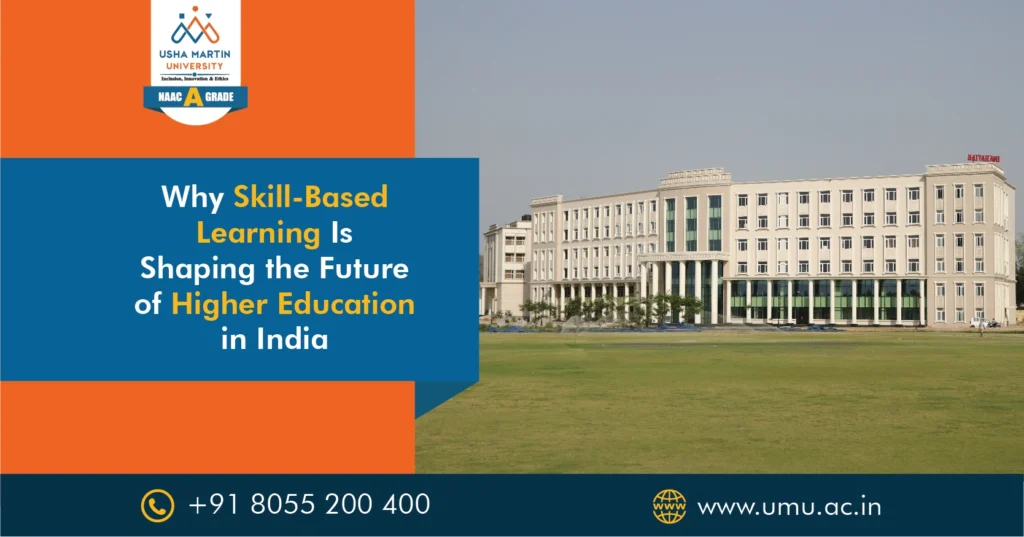
Higher education in India is changing faster than ever. A university degree is still important, but today, employers increasingly want something more from graduates: the ability to apply knowledge, solve problems, communicate effectively, use technology, and adapt to changing workplace requirements.
This is why skill-based learning is shaping the future of higher education in India. For you as a student, this shift means that choosing a university is no longer only about the name of the institution or the degree you receive. You should also ask: What will I actually learn? Will I get practical exposure? Can I work on real projects? Will I develop communication and digital skills? Will my program prepare me for the changing demands of industry?
The answer lies in combining academic knowledge with practical skills. At Usha Martin University (UMU), Ranchi, we believe higher education should help you become capable of using what you learn. With programs across engineering, management, computer applications, pharmacy, agriculture, physiotherapy, nursing, paramedical sciences, law, forensic science, and other disciplines, we focus on creating an environment where academic learning can connect with professional development. UMU is UGC-recognized and has received NAAC Grade A accreditation with a CGPA of 3.17.
What Is Skill-Based Learning?
Skill-based learning is an approach in which you do not simply study concepts for examinations. Instead, you learn how to use those concepts in practical situations.
For example, if you pursue a BTech degree, understanding programming concepts is important. But you also need to know how to develop software, analyze data, work with emerging technologies, collaborate with a team, and solve real-world technical problems.
Similarly, if you choose a paramedical program, theoretical knowledge is only one part of your education. You also need practical understanding, technical competence, professional communication, and familiarity with healthcare environments.
The same principle applies to undergraduate programs in business, agriculture, pharmacy, computer applications, science, law, and other disciplines. Skill-based learning therefore creates a bridge between what you learn in classrooms and what you are expected to do in the workplace.
Why Is Skill-Based Education Becoming Important in India?
India has one of the world’s largest young populations, creating enormous opportunities as well as a major responsibility for higher education institutions. The challenge is not simply to produce more graduates. We need graduates who can contribute effectively from the beginning of their professional careers.
Mercer | Mettl’s India Graduate Skill Index 2025 analyzed more than 1 million students across 2,700+ campuses and reported that only 42.6% of Indian graduates who applied for jobs were overall employable. The report also found that employers are increasingly looking for capabilities such as critical thinking, communication, and learning agility.
This tells us something important: a degree and employability are not automatically the same thing. Your degree gives you an academic foundation. Your skills determine how effectively you can apply that foundation. The latest NITI Aayog working paper on education and skilling also points towards this transition from credentials to learning outcomes. Its data indicates that aggregate employability among post-school degree holders, including polytechnic graduates, increased from 47.3% in 2019 to 56.4% in 2026, while also identifying opportunities to improve pedagogy, equipment, and apprenticeship or internship exposure.
This is why universities need to rethink how students learn.
NEP 2020 Has Given Skill-Based Learning a Major Push
The movement towards skill-based higher education is not simply an industry trend. It is also supported by India’s National Education Policy 2020.NEP 2020 calls for vocational education to be integrated into mainstream education and states that higher education institutions should offer vocational education, apprenticeships, and skill-based courses. It also emphasizes that students should develop both academic and vocational capabilities.
The policy also promotes multidisciplinary education and the development of 21st-century capabilities, including communication, critical thinking, creativity, problem-solving, and teamwork.The UGC has subsequently developed a student-centric curriculum and credit framework for undergraduate programs that incorporates flexible choice-based credits, multidisciplinary learning, and multiple entry and exit options.
There is also an important shift towards connecting skill education with academic credits. A recent Government of India statement noted that the National Credit Framework allows students to accumulate up to 50% of the total credits required through skill-based courses, while industry-institution linkages and internships are being encouraged to improve industry readiness.
In simple terms, higher education is moving from
- Study → Memorise → Examination → Degree
towards:
- Learn → Practice → Apply → Create → Become Employable
How Skill-Based Learning Can Benefit You
-
You Learn to Apply Knowledge
One of the biggest advantages of practical education is application.Imagine studying marketing without ever developing a campaign, learning computer science without building a project, or studying laboratory technology without understanding how equipment is used.Skill-based learning changes this experience.
When you participate in case studies, practical assignments, laboratory work, projects, and presentations, you begin to understand how academic concepts operate outside textbooks.This makes learning more meaningful and easier to connect with your future career.
-
You Become More Industry-Ready
Industries evolve continuously. Artificial intelligence, automation, cloud computing, cybersecurity, data analytics, digital healthcare, and advanced manufacturing are changing the nature of jobs.
The QS World Future Skills Index 2025 highlights the critical role of higher education in preparing students for future work and aligning education with changing skill requirements.
We therefore believe that your education should not prepare you only for the first job after graduation. It should help you develop the ability to keep learning throughout your career.
-
You Develop Problem-Solving Skills
Employers do not hire graduates simply because they can remember information.They hire people who can identify problems and find solutions.Project-based learning naturally develops this ability.
When you work on a project, you may face incomplete information, technical difficulties, deadlines, or unexpected results. You have to analyze the situation, discuss alternatives, and make decisions.That experience develops problem-solving skills that cannot be acquired effectively through memorization alone.
-
You Build Communication and Teamwork Skills
Technical knowledge can help you get noticed, but communication and teamwork often determine how effectively you perform at work.
Mercer | Mettl’s 2025 research highlights the growing importance of soft skills alongside technical capabilities in an AI-enabled workplace.
This is why presentations, group discussions, collaborative projects, seminars, workshops, and extracurricular activities matter.
When you learn to explain your ideas clearly, listen to others, and work with different personalities, you become better prepared for professional environments.
Skill-Based Learning Across Different Programs
Skill-based education is not restricted to technical courses.It can be integrated into almost every discipline.
-
B.Tech and Engineering
A BTech degree at Usha Martin University can give you an opportunity to build technical knowledge while developing practical capabilities relevant to modern engineering careers.
UMU offers B.Tech programs including Computer Science and Engineering, Civil Engineering, Mining Engineering, Mechanical Engineering, Electrical & Electronics Engineering, Artificial Intelligence & Machine Learning, Cyber Security, and Data Science.
For students choosing technology-oriented careers, skills such as programming, data analysis, cybersecurity, AI, machine learning, system design, and problem-solving can complement theoretical engineering knowledge.
-
Paramedical Programs
Healthcare is another field where practical competence is essential.UMU offers paramedical programs, including B.Sc. Medical Laboratory Technology and B.Sc. Operation Theatre Technology, along with other healthcare-related programs.
For you, learning in this area should involve more than understanding healthcare terminology. You need to develop technical familiarity, professional discipline, accuracy, communication, and practical understanding.This is why skill-oriented paramedical education can be valuable for students who want to build careers in the growing healthcare sector.
-
Management and Commerce
Business education also requires practical learning.A management student may need to understand financial decisions, marketing strategy, human resources, business communication, entrepreneurship, and data-driven decision-making.Case studies, presentations, internships, and business projects can help you understand how organizations actually function.
-
Computer Applications
Technology is changing almost every industry.Programs such as BCA, BCA Honors, and MCA can help students build a foundation in computing while developing specialized skills in areas such as cybersecurity, blockchain, mobile computing, and data science. UMU’s current program information includes these technology-oriented options.
-
Agriculture and Applied Sciences
Modern agriculture increasingly involves technology, scientific analysis, sustainable practices, and data.Students pursuing agriculture-related programs can benefit from practical exposure that helps them understand how scientific knowledge can be applied to real agricultural challenges.
Why Choose an NAAC A-Grade University in Ranchi?
When you search for an NAAC A-grade university in Ranchi, you should look beyond the grade itself. Accreditation is an important quality indicator, but your decision should also consider academic programs, infrastructure, faculty, learning environment, practical exposure, student support, and opportunities for professional development.
Usha Martin University received NAAC Grade A accreditation in 2025 with a score of 3.17. The university’s annual report states that the accreditation followed evaluation of areas including teaching-learning, research, infrastructure, and institutional practices.
For us, this recognition is not simply a label. It represents an opportunity to keep improving the learning experience we provide. If you are comparing universities in Ranchi, consider whether the institution can give you the combination of academic credibility + practical learning + professional exposure + future-oriented skills.
From undergraduate programs to postgraduate programs
Skill-based learning does not end with graduation. As you progress from undergraduate programs to postgraduate programs, the depth and complexity of skills should also increase.
At the undergraduate level, you may develop foundational technical and professional abilities. At the postgraduate level, you can move towards advanced problem-solving, research, leadership, specialization, and strategic decision-making.
UMU offers programs at diploma, undergraduate, postgraduate, and doctoral levels across multiple disciplines. This gives students opportunities to continue their academic journey while developing skills at different stages.
Diploma Programs: A Practical Route to Skill Development
Diploma programs can be particularly valuable for students who want focused, career-oriented education. A diploma can help you build specific technical knowledge and practical competencies without necessarily following the same pathway as a conventional degree program.
UMU offers diploma programs in areas including mining, mechanical, computer science, electrical, and civil disciplines, along with pharmacy and other programs. For some students, a diploma can serve as a direct route into employment or as a foundation for further education.
What Should You Look for in a Skill-Based University?
If you are planning admission in 2026, do not select a university only because someone called it the “best” or “top university in India.”
Instead, ask practical questions.
- Does the university provide modern laboratories?
- Does your program include practical assignments?
- Can you participate in projects?
- Are internships encouraged?
- Does the curriculum reflect emerging technologies?
- Are communication and soft skills included?
- Does the institution provide career guidance?
- Are there opportunities to interact with industry?
- Does the university support innovation and entrepreneurship?
These questions can help you make a more informed decision.
Why Usha Martin University Fits the Changing Education Model
Usha Martin University was established in 2012 and is recognized by the UGC under Section 2(f) of the UGC Act. It is also a member of the Association of Indian Universities.
Our academic portfolio covers a wide range of disciplines, allowing students with different interests to pursue higher education within one institution. The university’s undergraduate offerings include engineering, computer applications, forensic science, applied sciences, and paramedical programs, among others. Its current B.Tech portfolio includes emerging areas such as AI & machine learning, cybersecurity, and data science.
The university also describes its programs as being supported by case studies, live projects, assignments, and group discussions, linking academic learning with professional requirements. Our approach is therefore based on an important idea: education should help you become capable, not merely qualified.
The Future Will Belong to Lifelong Learners
Perhaps the biggest reason skill-based learning is becoming important is that no degree can teach you everything you will need throughout your career.
- Technology will change.
- Job roles will change.
- Industries will change.
Some jobs that exist today may look completely different ten years from now. Therefore, the most valuable skill you can develop is the ability to learn continuously. If you learn how to research, analyze, communicate, collaborate, experiment, and adapt, you become better prepared for uncertainty.
This is also why we should not think of skill-based education as simply vocational training. It is much broader. It includes technical skills, digital skills, communication, leadership, creativity, critical thinking, entrepreneurship, and the ability to learn.
Admission Open 2026: Think Beyond the Degree
If you are currently searching for admission open in 2026 opportunities in Ranchi, this is the right time to think carefully about what you want from your higher education. Do you want only a certificate? Or do you want an education that can help you build confidence, competence, and career readiness?
At Usha Martin University, we offer a broad portfolio of diploma, undergraduate, and postgraduate programs for students with different academic and career goals. The university’s 2026-27 admission information lists programs across management, computer applications, engineering, pharmacy, nursing, paramedical sciences, agriculture, law, forensic science, and other disciplines.
Our goal is to create an environment where you can learn concepts, practice skills, explore interests, and prepare for the professional world.
Conclusion
The future of higher education in India will not be defined by degrees alone. It will be defined by what students can do with their degrees. The evidence is increasingly clear. Employers want graduates who can combine technical knowledge with communication, critical thinking, learning agility, and adaptability. Government policy is also moving towards integrating vocational and skill-based education into mainstream higher education.
For you, this creates an important opportunity. When choosing between universities, courses, or career paths, look beyond the syllabus. Look at the skills you will develop, the practical exposure you can receive, and the kind of professional you can become.
Whether you are exploring a B.Tech degree for Usha Martin University, paramedical programs, management, computer applications, agriculture, pharmacy, law, or other undergraduate and postgraduate programs, make your decision with your future in mind.
And if you are searching for a top university in India, a NAAC A grade university in Ranchi, or career-oriented diploma programs, remember that the strongest education is the one that helps you turn knowledge into action.At Usha Martin University, we believe your degree should be more than a qualification.It should become a foundation for your skills, confidence, career, and lifelong learning.
Frequently Asked Questions (FAQ’s)
Q1: Why is skill-based learning important in higher education?
Skill-based learning helps you apply theoretical knowledge to practical situations. It can improve problem-solving, communication, technical competence, and workplace readiness.
Q2: Is skill-based education useful for B.Tech students?
Yes. Engineering students can benefit from practical projects, laboratory work, internships, and emerging technology exposure alongside theoretical concepts.
Q3: Does Usha Martin University offer skill-oriented programs?
Yes. UMU offers programs across engineering, computer applications, management, pharmacy, agriculture, paramedical sciences, and other disciplines, with several programs incorporating practical and professional learning approaches.
Q4: What should I check before choosing a university in Ranchi?
You should consider accreditation, program quality, faculty, infrastructure, practical learning, internships, industry exposure, career support, and opportunities for higher education.
Q5: Is admission open at Usha Martin University for 2026?
Yes. Usha Martin University’s official admission information lists Admission Open 2026-27 and provides program options across multiple disciplines.