Why Skill-Based Learning Is Shaping the Future of Higher Education in India
August 25, 2026
Stepping into Campus Life: UMU’s 5-Day Deekshaarambh Programme
September 2, 2026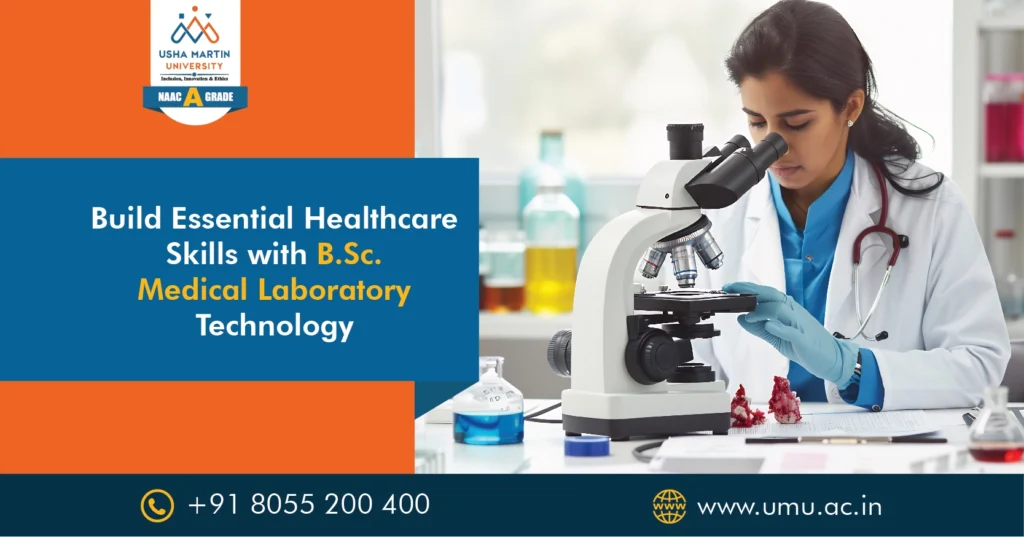
B.Sc. Medical Laboratory Technology admission, B.Sc. Medical Lab Technology course. After 12th B.Sc. MLT programs, B.Sc. MLT course in Ranchi, B.Sc. MLT programs, paramedical course admission
The healthcare sector has significantly gained popularity among students to learn about laboratory training and handling clinical samples to collect, process, examine, and clarify. Learn about diagnostic procedures and medical laboratories to take a potential job role in modern healthcare. BSc Medical Lab Technology (B.Sc. MLT) courses in India are three years and five months long, where students will learn about the healthcare sector to handle equipment and manage quality control for professional practices.
In this blog, students will discover the industry-relevant curriculum, eligibility to take admission, professional skills learned, and career opportunities to help students prepare for the growing healthcare sector.
What is B.Sc. Medical Laboratory Technology?
It is an undergraduate allied healthcare program that focuses on the scientific and technical aspects of medical laboratory work, where biological specimens and clinical samples are used to support the diagnosis, treatment, and monitoring of diseases. The program covers biology, physiology, biochemistry, microbiology, hematology, and laboratory instrumentation. It is best to enroll after 12th B.Sc. MLT programs to make a career in the science field and prepare for career in clinical research.
Choosing a healthcare industry prepares students with diagnostic techniques, ensure to handle the equipment correctly and perform to get the results.
-
Develop Healthcare-specific Knowledge
In this undergraduate degree program, students will discover the scientific principles, human anatomy, therapeutic interventions, symptom awareness, medical history diagnosis, along with surgical techniques, nursing care, and understanding hospital workflows with respect to institutional policies and public health regulations.
-
Explore Multiple areas of Diagnostics:
Understand medical diagnostics, automotive diagnostics, incorporating technology to generate reports through computerized systems, and electrical diagnostics to identify a problem, determine a cause, and use evidence to test and guide the solution.
-
Develop Healthcare-specific Knowledge
In this undergraduate degree program, students will discover the scientific principles, human anatomy, therapeutic interventions, symptom awareness, medical history diagnosis, along with surgical techniques, nursing care, and understanding hospital workflows with respect to institutional policies and public health regulations.
-
Explore Multiple areas of Diagnostics:
Understand medical diagnostics, automotive diagnostics, incorporating technology to generate reports through computerized systems, and electrical diagnostics to identify a problem, determine a cause, and use evidence to test and guide the solution.
-
Work in the Healthcare Sector:
Students can consider planning their learning with hospitals, diagnostic laboratories, research facilities, blood banks, and healthcare organizations.
-
Develop a Foundation for Further Education:
Students with their bachelor’s degree in MLT can consider postgraduate education in laboratory science, biotechnology, healthcare and other relevant disciplines.
Students can consider planning their learning with hospitals, diagnostic laboratories, research facilities, blood banks, and healthcare organizations.
-
Develop a Foundation for Further Education:
Students with their bachelor’s degree in MLT can consider postgraduate education in laboratory science, biotechnology, healthcare and other relevant disciplines.
Explore UMU B.Sc. MLT Programs Curriculum
Semester 1
After paramedical course admission, in this first semester, students will learn through a strong foundation in human biology, computer applications, and basic professional skills, relevant subjects. This semester also covers laboratory science-relevant topics for disease diagnosis and clinical specimens to prepare students with professional etiquette, time management, problem solving to build technical competencies.
| Subject Code | Subject |
| BMLT-101 | Human Anatomy & Physiology I |
| BMLT-102 | Fundamentals of Biochemistry I |
| BMLT-103 | Basic Hematology & Clinical Pathology I |
| BMLT-104 | Computer Applications |
| BMLT-105 | English Communication & Soft Skills |
| BMLT-106 | Human Anatomy & Physiology I: Practical |
| BMLT-107 | Fundamentals of Biochemistry I: Practical |
| BMLT-108 | Basic Hematology & Clinical Pathology I-Practical |
| BMLT-109 | Computer Applications: Lab |
Semester 2
In the Semester 2 program, students will strengthen their understanding of community health, laboratory instrumentation, and module-relevant concepts to build skills relevant to the public health competencies.
| Subject Code | Subject |
| BMLT-201 | Human Anatomy & Physiology II |
| BMLT-202 | Fundamentals of Biochemistry II |
| BMLT-203 | Basic Hematology & Clinical Pathology II |
| BMLT-204 | Biomedical Instrumentation Techniques |
| BMLT-205 | Preventive & Community Health Care |
| BMLT-206 | Human Anatomy & Physiology II: Practical |
| BMLT-207 | Fundamentals of Biochemistry II: Practical |
| BMLT-208 | Basic Haematology & Clinical Pathology II-Practical |
| BMLT-209 | Biomedical Instrumentation Techniques: Lab |
Semester 3
In the third semester, students will discover the topics relevant to diagnostic approaches, biochemical research, basic laboratory safety, and several diagnostic significances for detecting disease, and understand immunology. Students will also learn about medical laboratory technology.
| Subject Code | Subject |
| BMLT-301 | General Microbiology I |
| BMLT-303 | Clinical Biochemistry I |
| BMLT-303 | Immunology & Serology I |
| BMLT-304 | Clinical Hematology |
| BMLT-305 | General Pathology & Basic Techniques |
| BMLT-306 | General Microbiology I: Practical |
| BMLT-307 | Clinical Biochemistry I: Practical |
| BMLT-308 | Immunology & Serology I: Practical |
| BMLT-309 | Clinical Hematology: Practical |
Semester 4
In this semester, students will learn about clinical biochemistry, immunology & serology, histopathological specimen processing, and staining. The prime focus of this semester is clinical training and laboratory practices with advanced diagnostic techniques.
| Subject Code | Subject |
| BMLT-401 | General Microbiology II |
| BMLT-402 | Clinical Biochemistry II |
| BMLT-403 | Immunology & Serology II |
| BMLT-404 | Histopathology & Histotechniques |
| BMLT-405 | General Microbiology II: Practical |
| BMLT-406 | Clinical Biochemistry II: Practical |
| BMLT-407 | Immunology & Serology II: Practical |
| BMLT-408 | Histopathology & Histotechniques II: Practical |
| BMLT-409 | Clinical training & Seminar in clinical issues. |
Semester 5
In the third year and beginning of the fifth semester, students will understand the medical laboratory techniques to detect toxic substances in the human body, evidence handling, and basic forensic procedures. This semester’s topics also cover virology and mycology through microscopic and laboratory techniques.
| Subject Code | Subject |
| BMLT-501 | Clinical Endocrinology & Toxicology |
| BMLT-502 | Forensic Science |
| BMLT-503 | Cytopathological technique |
| BMLT-504 | Parasitology |
| BMLT-505 | Virology & Mycology |
| BMLT-506 | Clinical Endocrinology & Toxicology: Practical |
| BMLT-507 | Cytopathological technique: Practical |
| BMLT-508 | Parasitology: Practical |
| BMLT-509 | Clinical training & Seminars in clinical issues |
Semester 6
In the final semester, students will enhance their clinical laboratory practical skills with advanced diagnostic skills, quality and safety procedures in blood banks, instrumentation skills, research design, data collection, scientific writing, research ethics, quality practices, clinical competence, and medical laboratory technology.
| Subject Code | Subject |
| BMLT-601 | Immunohematology & Blood Banking |
| BMLT-602 | Advanced Diagnostic Techniques |
| BMLT-603 | Clinical & molecular biology |
| BMLT-604 | Bacteriology |
| BMLT-605 | Biostatistics & Research methodology |
| BMLT-606 | Immunohematology & Blood banking: Practical |
| BMLT-607 | Advanced Diagnostic techniques: Practical |
| BMLT-608 | Clinical & Molecular Biology: Practical |
| BMLT-609 | Bacteriology: Practical |
| BMLT-610 | Clinical training & Seminars in clinical issues |
Essential Skills Learnt with B.Sc. MLT
- Laboratory Techniques: Through the B.Sc. module sessions, students will learn about laboratory procedures, prepare samples, perform tests, and safe techniques of laboratory equipment handling.
- Sample Collection and Handling: Students will learn to take correct sample collection, labeling, storage, and transportation for obtaining reliable laboratory results.
- Analytical Skills: Students will learn to carefully examine test results and identify inconsistencies to process the investigation for accurate results.
- Equipment Handling: It is one of the essential skills for laboratory professionals to learn about modern laboratory tools and automate the system to generate results.
- Quality Control: Ensuring quality and understanding the control procedures, laboratory safety, and documentation are some of the processes to manage quality control.
- Attention to Detail: Identifying the details of small errors in sample identification, preparation, documentation, and testing that require strong attention to detail.
- Communication Skills: Professional communication to work with doctors, technicians, patients, nurses, and healthcare professionals for day-to-day operations and collaboration.
Conclusion
A BSc MLT course in Ranchi, students will learn about the allied healthcare sector, where medical science, practical training, and diagnostic knowledge can develop skills relevant to modern laboratory environments. Identify healthcare, technology, science, and laboratory work for practical competence, ethical responsibility and supporting quality patient care.
Frequently Asked Questions (FAQs)
Q1: What is B.Sc. Medical Laboratory Technology?
It is an undergraduate healthcare program to prepare students to perform laboratory diagnosis, treatment and monitoring of diseases.
Q2: Is B.Sc. MLT a practical-oriented course?
Yes, it is one of the important components of the program to handle equipment, microscopy, laboratory testing, blood banking, and learn several other diagnostic procedures.
Q3: Is Internship or clinical training included?
The course offers five months of training along with laboratory practical workflows covered per semester.
Q4: What career opportunities are available after B.Sc. MLT?
Candidates can explore career opportunities in medical laboratory technology, pathology, blood bank technology, research assistant, and quality assurance roles.
Q5: Is computer knowledge important for an MLT professional?
Yes, Modern laboratories are optimized with computerized systems for patient registration, test-result entry, sample tracking, reporting data, and quality monitoring for professional MLT practice.